Cluster feeding: why your newborn wants to feed every hour in the evening
Published 1 October 2026 · Dao Van Thuong · 6 min read
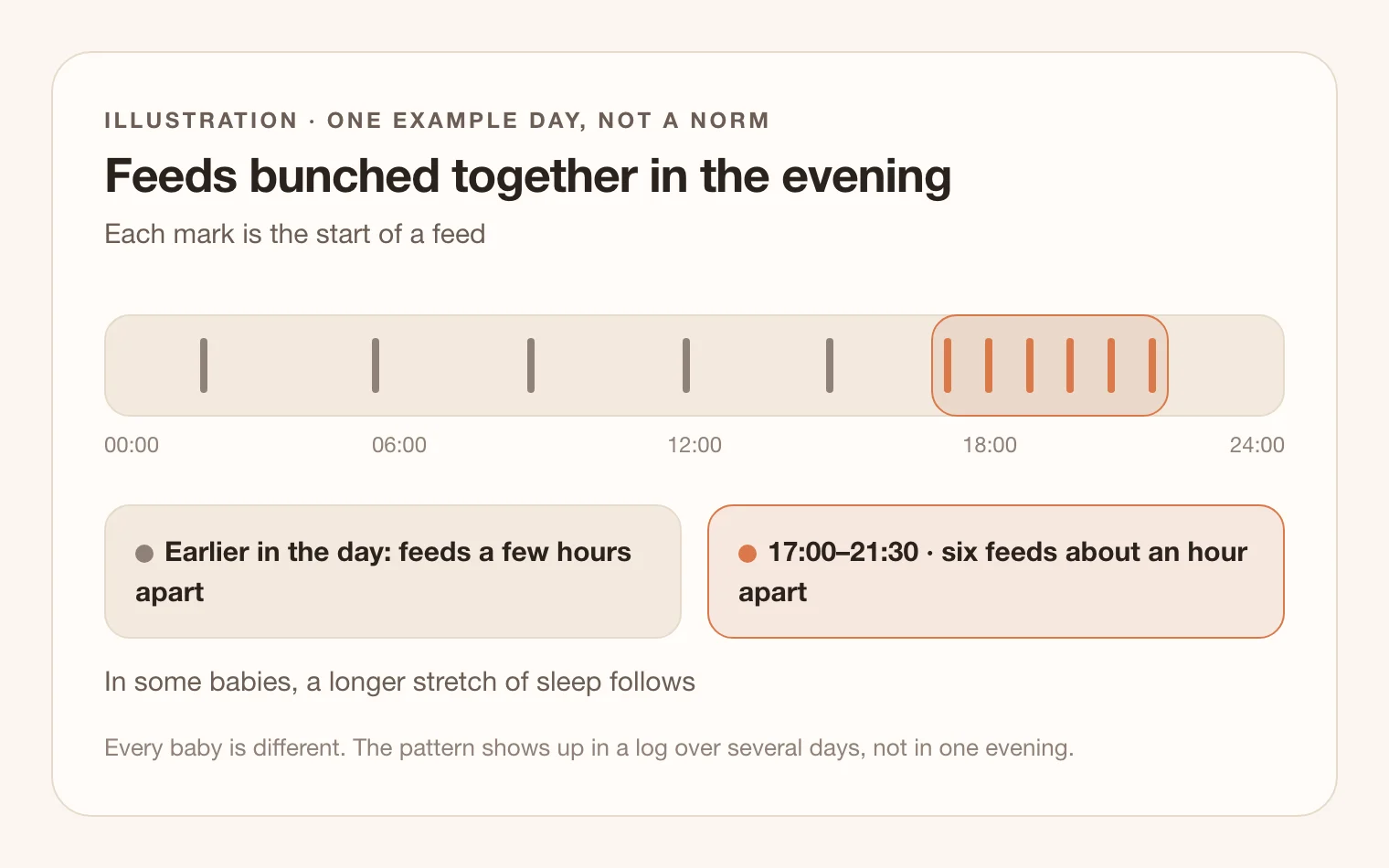
Cluster feeding is when a baby has several short feeds much closer together than usual — often every hour or so for a few hours, most commonly in the late afternoon and evening. Public health sources such as Cleveland Clinic describe it as common and normal in the early weeks, and it does not by itself mean you are short of milk.
What matters is the whole picture: whether the bunching comes and goes, and whether diapers and weight checks look the way your care team expects. Below is what cluster feeding looks like, how to cope with the evenings, how to log it so you can see the pattern, and the signs that mean you should call rather than wait.
This guide is general information, not medical advice. Follow what your doctor, midwife or health visitor told you, and call emergency services in an emergency.
What does cluster feeding look like?
A typical description from parents: the baby feeds, settles for a few minutes, roots again, feeds briefly, fusses, wants the breast or the bottle again — and this repeats for two, three or more hours. Earlier in the day the same baby may have gone a few hours between feeds without trouble.
- The feeds are often short and close together rather than one long feed.
- It tends to happen at the same time of day, very often in the evening.
- The baby may be fussy between feeds and calmer at the breast or bottle.
- In some babies a longer stretch of sleep follows the cluster, though not always.
Cleveland Clinic notes that very frequent feeding is normal around the clock in the first days of life, that evenings are the most common time later on, and that bunched feeds also show up during growth spurts and developmental leaps.
Why do babies cluster feed?
Nobody can tell you exactly why your baby is doing it tonight, but the general explanations given by sources such as Cleveland Clinic and breastfeeding organisations are reassuringly ordinary:
- Newborns have small stomachs and need to refuel often.
- Milk supply and the hormones behind it naturally vary over the day; many parents find evenings the slowest time.
- Feeding is also comfort and closeness, and tired babies often want both at the end of the day.
- Growth spurts and new skills can bring a few days of extra feeding.
Cluster feeding happens with bottle-fed babies too, although it is most often discussed with breastfeeding. If you breastfeed, frequent feeding is also how supply is built and adjusted, which is one reason lactation specialists generally advise feeding on cue rather than to the clock.
How do I get through cluster feeding evenings?
The evenings are tiring because they are long and unpredictable, not because anything is wrong. A little preparation helps:
- 1Set up a feeding spot before the evening starts: water, a snack, phone charger, burp cloth, the log and a pen within reach.
- 2Eat your own dinner early, or let someone hand you food you can eat with one hand.
- 3If you have a partner, agree that the evening is when they take everything else — older children, dishes, the door — so you can stay put.
- 4Offer both breasts if you breastfeed, and follow the advice your midwife or lactation consultant gave you about switching sides.
- 5Swap if you can. If the baby takes expressed milk or formula, another adult can cover part of the evening so you can sleep earlier and take a later shift instead.
- 6Lower the bar for the rest of the evening. Cluster feeding usually passes; the housework will still be there.
Keep the usual safety rules even when you are exhausted: if you think you might fall asleep while feeding, do it somewhere safe rather than on a sofa or armchair, as the AAP's safe sleep guidance warns.
How does a log show whether it is cluster feeding?
In the middle of a long evening it is hard to judge anything. A few days of notes make it much clearer. For each feed, write only the start time and, if you like, the side or the amount — nothing more is needed.
- If the close feeds sit in the same few evening hours each day and the rest of the day looks calmer, that is the classic picture.
- If the feeds are close together all day and all night, every day, that is a different picture worth discussing with your care team.
- Add the diaper count for each day next to the feeds. Wet and dirty diapers, together with weight checks, are what your midwife or doctor uses to judge intake — the number of feeds alone does not answer that.
Count feeds from the start of one to the start of the next. When you show the log to a professional, a column of start times answers most of their questions at a glance.
When should I call the doctor or midwife?
Cleveland Clinic advises calling your pediatrician if a baby older than about a week is feeding almost constantly, around the clock, because that can be a sign of not getting enough milk. Also call your doctor, midwife or a lactation consultant if:
- wet or dirty diapers drop off compared with the previous days, or are fewer than your care team told you to expect;
- your baby is very sleepy and hard to wake for feeds, or seems weak or floppy;
- feeding is painful for you, the latch looks shallow, or the baby seems to suck without swallowing;
- your baby has a fever, is unusually pale or yellow, or simply looks unwell to you.
None of this needs to wait for a full day of notes. If you are worried, call. In an emergency, call your local emergency number.
Where Baton helps
Baton makes the start-time column effortless. Breastfeed, Bottle and Pump are big buttons in the bottom half of the screen, the breastfeeding timer remembers which side is next, and if you forgot to press start you can begin the feed 5, 10, 15 or 30 minutes ago. Each save has a 5-second Undo and every time can be edited later.
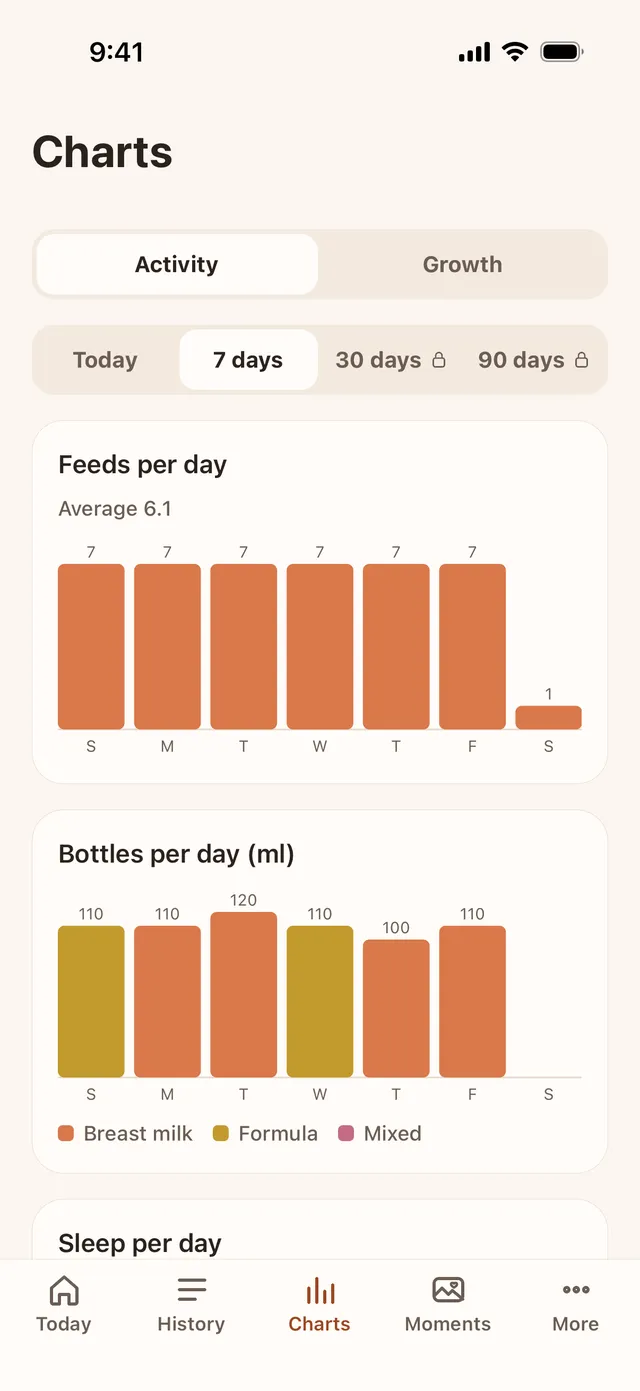
Charts shows today's timeline and 7 days of feeds, bottles, sleep and diapers per day for free, so an evening cluster stands out as a pattern rather than a feeling; 30- and 90-day trends come with Baton Plus. Both parents log into the same history through their own iCloud, so whoever takes the late shift sees the evening's feeds without asking.
Baton does not judge whether your baby is getting enough. It keeps the record your midwife or doctor will ask about, and the core of it is free.