Newborn day-night confusion: how to help your baby tell day from night
Published 25 October 2026 · Đào Văn Thương · 5 min read
“My newborn sleeps all day and is wide awake all night.” Parents often call this day-night confusion or day-night reversal. It is common in the first weeks, and it is exhausting, especially when it seems to have no end.
This guide explains what public guidance suggests for helping a baby tell day from night, and how to write down a few days of sleep so you can see whether the pattern is changing. It is general information, not medical advice. If you are worried about your baby's sleep or feeding, ask your midwife, health visitor or doctor.
This guide is general information, not medical advice. Follow what your doctor, midwife or health visitor told you, and call emergency services in an emergency.
What is day-night confusion?
Newborns do not start life with a day-and-night rhythm. They sleep in short pieces around the clock and wake to feed whenever they are hungry, so the longest stretch can land at any hour, including mid-afternoon. When it lands in the evening or at night and the baby is alert while the household wants to sleep, it feels like the days and nights are swapped.
It is a normal stage, not something a parent caused, and it is usually temporary. Exactly when it eases differs from baby to baby, so be wary of any page that promises a specific week.
What do the NHS and the AAP suggest?
The NHS advice on helping your baby to sleep suggests teaching a baby early that night is different from day. By day, open the curtains, play with your baby and do not worry too much about everyday household noise while they nap. At night, keep the lights low, talk quietly, put your baby down as soon as they have been fed and changed, and do not play with them.
The American Academy of Pediatrics (AAP), on its HealthyChildren.org page about day-night reversal, likewise suggests a routine that clearly separates day from night: quiet and calm at night, with night-time contact kept to feeding, burping, changing and soothing.
These are habits, not a method with a guaranteed result. Keep the safe-sleep basics at every sleep, day and night: baby on their back, on a flat, firm surface of their own, in your room. See our guide on how much a newborn sleeps.
What can I do in the day and at night?
- In the day, feed and change your baby in a bright room, and let them nap where the normal noise of the home carries on. Short naps on the go are fine.
- In the evening, begin to wind down: dimmer lights, quieter voices, the same few steps each time.
- At night, keep it boring: low light, little talk, feed, burp, change, back to sleep. A screen on full brightness is worse than a small night light, so dim your phone if you use it.
- Do not wake a baby on a rigid schedule to “fix” the rhythm. If your doctor or midwife has asked you to wake your baby for feeds, follow that advice.
- Share the load. If one parent takes the first part of the night and the other the second, each gets one longer stretch of sleep. See our guide on splitting night shifts.
How do I see whether it is changing?
From inside a tired week it is hard to tell whether anything is improving. A short log can show it. For about a week, write down two times for every sleep, when the baby fell asleep and when they woke, on paper or in your phone.
At the end of each day, find the longest single stretch and note roughly when it started. Then compare days:
- Is the longest stretch drifting toward the night, or still landing in the afternoon?
- How much of the 24 hours is slept at night and how much by day? The exact total matters less than whether the split is shifting.
- Is one bad night followed by a good one? One rough night is not a trend.
Bring the log to your next checkup. “Longest stretch is 2 to 3 hours and it is usually between noon and 3 pm” is more useful to a health visitor than “they never sleep at night”.
How does Baton help?
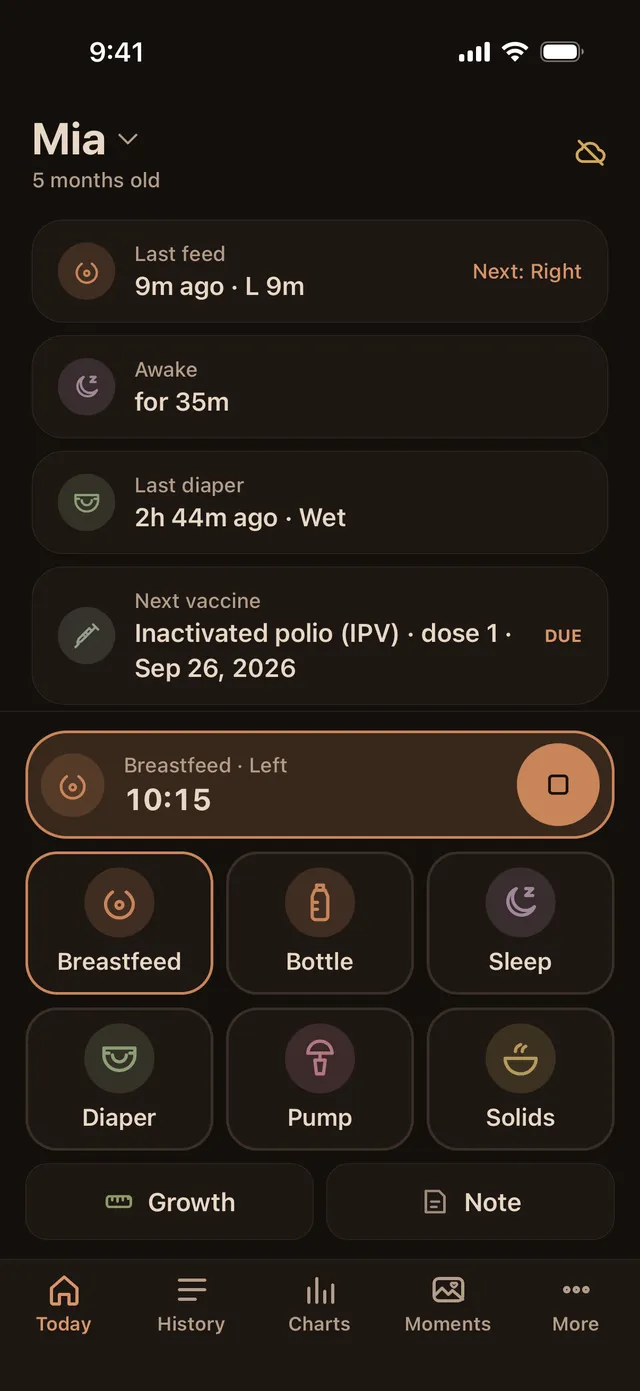
Start the sleep timer when the baby falls asleep and stop it when they wake, or add the times afterwards. If you forget to press start, you can begin the timer 5, 10, 15 or 30 minutes ago, and the times of any entry can be edited.
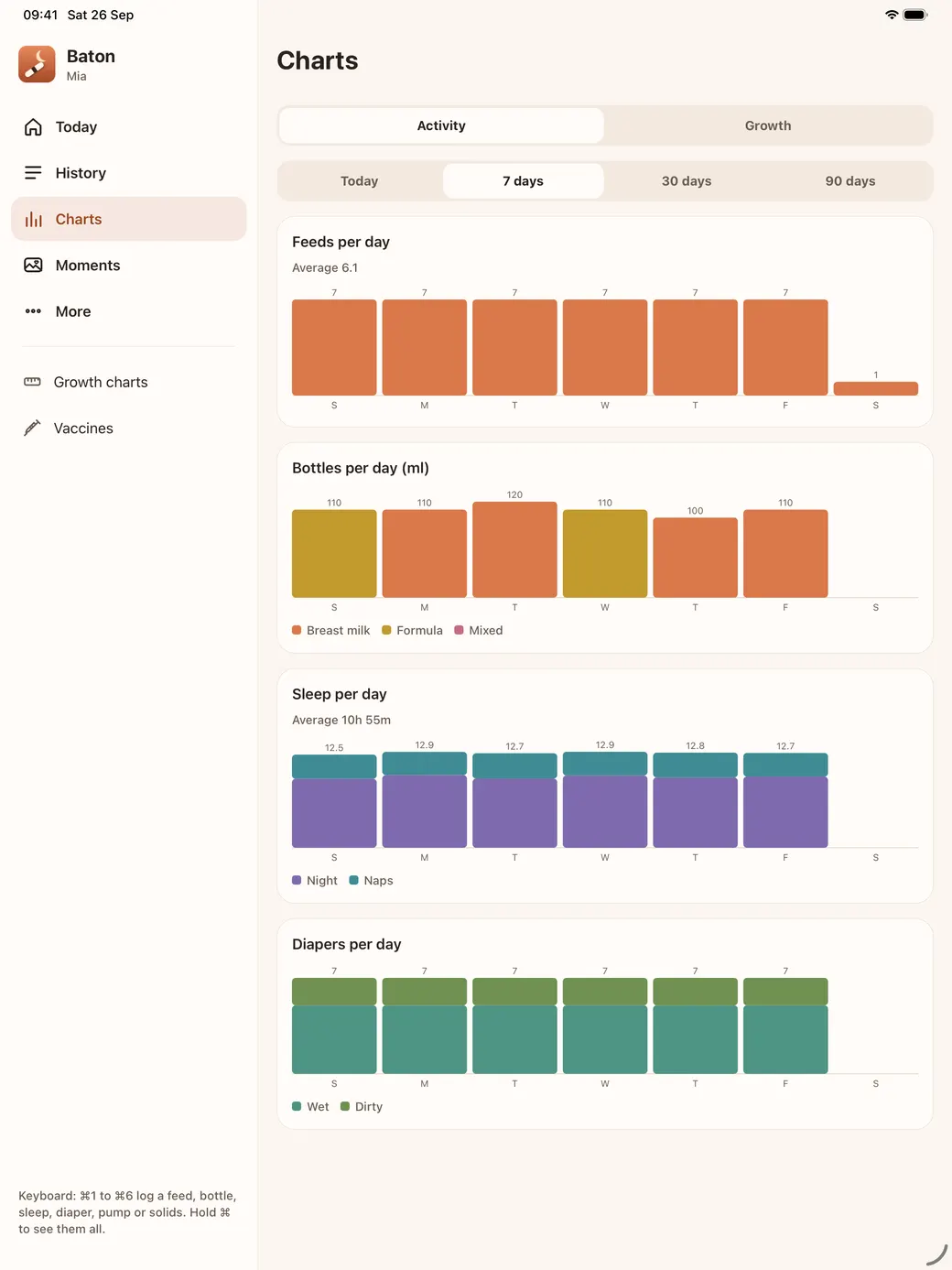
On the Charts screen, the Sleep card for a day adds up the total, splits it into naps and night, and shows the longest stretch. Baton counts a sleep as night when it starts between 19:00 and 05:59 and as a nap otherwise; that rule is fixed, so a baby who falls asleep at 18:30 is counted under naps. The Sleep per day chart for the last 7 days is free; 30- and 90-day trends are part of Baton Plus. CSV export of every entry is free.
Night mode keeps the screen dark and warm for 3 AM, and if your partner uses Baton through their own iCloud account, they see the same sleeps, each marked with who logged it. Baton only records what you enter; it does not tell you how your baby should sleep.
When should I ask for help?
Ask your midwife, health visitor or doctor if your baby is very hard to wake for feeds, seems unusually floppy or unresponsive, is not feeding well, has fewer wet or dirty diapers than your care team expects, has a fever, or if anything about their sleep worries you. You do not need a log to justify a call. In an emergency, call your local emergency number.
Frequently asked questions
- Why is my newborn awake at night and asleep all day?
- Newborns do not yet have a day-and-night rhythm and sleep in short pieces around the clock, so the longest stretch can fall at any hour. It is common and usually temporary. Ask your midwife or health visitor if you are worried.
- How long does newborn day-night confusion last?
- It differs from baby to baby, and there is no exact date. A few days of logged sleep times can show whether the longest stretch is moving toward the night. Ask your health visitor or doctor if you are concerned.
- What does the NHS suggest to help a baby tell day from night?
- The NHS suggests keeping days bright and sociable, with everyday noise, and keeping nights dim and quiet: low lights, quiet talk, putting the baby down once fed and changed, and no playing.
- Should I wake my baby during the day to fix it?
- Do not do it on a rigid schedule on your own. If your doctor or midwife has asked you to wake your baby for feeds, follow their advice, and ask them if you are unsure.
- Can Baton show how much my baby sleeps at night and by day?
- Yes. The Charts screen splits each day's sleep into naps and night, and shows the longest stretch. A sleep that starts between 19:00 and 05:59 counts as night. The 7-day view is free.