Baby spits up a lot: how to keep a simple spit-up log for your health visitor or pediatrician
Published 6 November 2026 · Đào Văn Thương · 5 min read
“Is it normal that my baby spits up after every feed?” is a question parents type in at 3 AM with a damp burp cloth in hand. Public health sources say that bringing up a little milk is common in young babies. They also list signs that need a call. A short record helps you tell the two apart, and gives your health visitor or pediatrician something better than “a lot”.
This guide explains what the NHS says, what is worth writing down, and how to keep that record on paper or in Baton: Baby Tracker. It is general information, not medical advice. Whether your baby's spit-up is normal is a question for your pediatrician, midwife or health visitor.
This guide is general information, not medical advice. Follow what your doctor, midwife or health visitor told you, and call emergency services in an emergency.
What do NHS pages say about spitting up and reflux?
NHS pages on reflux in babies describe it as common: a baby under one year may bring up a little milk during or soon after a feed. They say a baby with reflux who is happy, healthy and gaining weight does not usually need to see a doctor, and that it tends to start in the first weeks and get better with time. Check the NHS page itself for the current wording.
The same pages list reasons to get help. Examples include a baby who is not gaining weight or is losing weight, who refuses feeds or seems uncomfortable after most feeds, vomit that is green or yellow-green or has blood in it, forceful (projectile) vomiting, a swollen tummy, blood in the poo, a high temperature, or being sick again and again and not keeping fluids down. Some of these need urgent care the same day. If you are unsure which applies, call your doctor, your local advice line (NHS 111 in the UK) or your emergency number.
Why does a log help?
“He spits up all the time” can mean one small dribble after each feed or a full-on vomit twice a day, and your care team cannot tell which from the words alone. Care teams sometimes ask parents to note how often their baby brings milk back up and how much, together with what the baby takes in. A few days of notes turns a worry into something a nurse or doctor can read in a minute.
A log also answers a question that is hard to answer by memory: is it getting better, worse or just the same? And it keeps the count honest on a bad day, when it feels like every feed came back.
What should I write down?
Keep it short, because you will be doing it with a baby on your shoulder:
- The time of the spit-up, and which feed it followed (the feed's time is enough).
- How much, in words you can repeat later: a dribble, a mouthful, a whole feed, soaked a bib or a burp cloth. Do not try to measure it in millilitres.
- How it came up: effortlessly, or forcefully (shot out), and how your baby was afterwards: happy, fussy or crying.
- What it looked like, if anything is not just milk: green, yellow-green, blood, or a lot of curds. Take a photo too.
- What the feed was: breast or bottle, and how much milk your baby took.
- Anything else the same day: a fever reading, fewer wet diapers, a feed refused.
The feeding side of this log is the same one you already keep. Our guide on whether your baby is getting enough milk explains the other numbers care teams look at, and the wet diaper guide explains how to count them.
How do I keep a spit-up log in Baton?
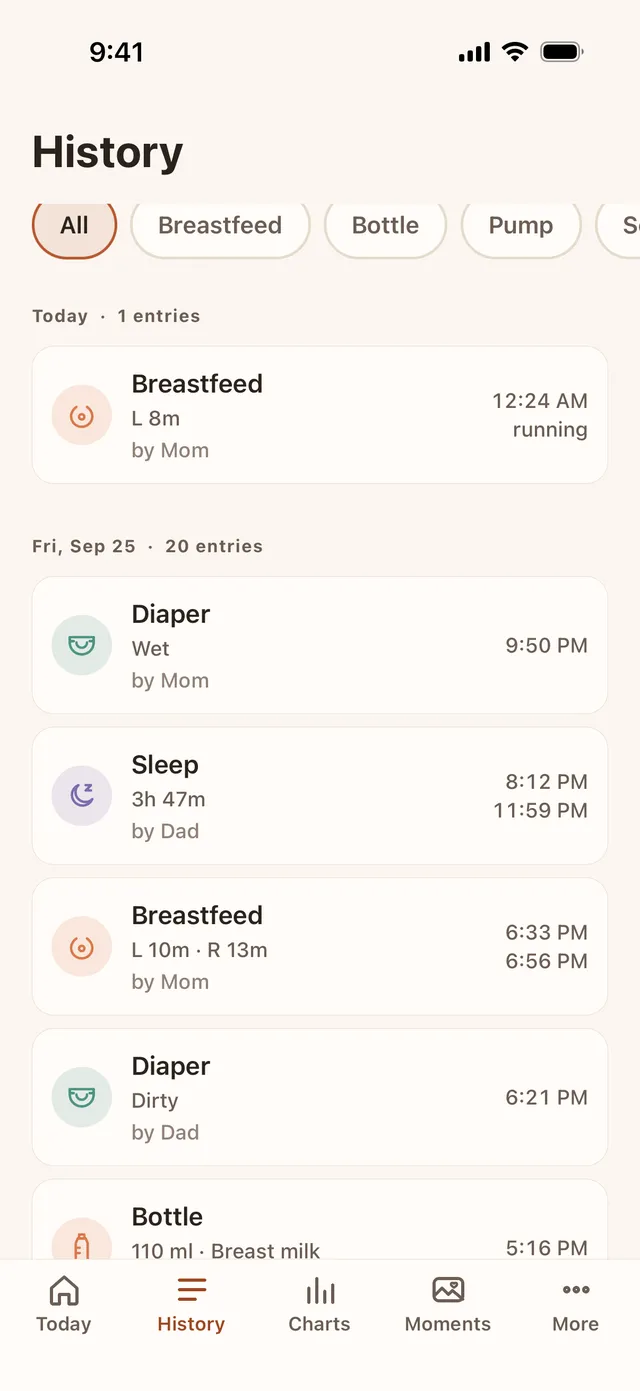
Baton has no dedicated spit-up button, and it does not count or judge spit-ups. It does let you attach a note to an entry, so the simplest way is to write the spit-up on the feed it followed. Open the breastfeed or bottle in History, add a short note such as “spat up a mouthful, happy after” in the Note field, and save. Or, if it did not follow a logged feed, tap Note on the Today screen and write one line. Every entry has an editable time, and shows who logged it, so your partner's notes join yours.
In History, a note appears under the entry it belongs to, so you can scroll back over a few days and read the spit-ups next to the feeds. Entries sync through each parent's own iCloud, and CSV export is free and has a note column, so you can search your notes in a spreadsheet. Plain notes are not printed in Baton's PDF summary for the doctor, so for an appointment, show the History screen or send the CSV.
When should I not wait for the log?
Do not wait to finish a log if your baby's vomit is green, yellow-green or bloody, if the vomiting is forceful or repeated, if your baby is not keeping feeds down, is very sleepy, floppy or pale, is breathing faster than usual, has a swollen tummy, or has a high temperature, or if you simply feel something is wrong. Call your doctor or NHS 111 (or your local equivalent) at once. Call your emergency number if your baby is struggling to breathe or is hard to wake. Bring the log to the next routine appointment too, and ask what changes to feeding, if any, are right for your baby.
Frequently asked questions
- Is it normal for a baby to spit up after every feed?
- NHS pages describe bringing up a little milk as common in babies under one year, and say a happy, healthy baby who is gaining weight does not usually need a doctor. Ask your pediatrician, midwife or health visitor about your baby.
- What should I write in a spit-up log?
- The time and the feed it followed, roughly how much (a dribble, a mouthful, a whole feed), whether it came up gently or forcefully, how your baby was afterwards, and anything that looked unusual, such as green or bloody vomit.
- Does Baton have a spit-up tracker?
- No. Baton has no spit-up button and gives no assessment. You can add a note to a feed or a standalone Note, read it in History and export it in the free CSV.
- When should I call the doctor about spit-up?
- Soon if your baby is not gaining weight, refuses feeds or seems uncomfortable. Right away if the vomit is green, yellow-green or bloody, forceful, repeated, or your baby is floppy, very sleepy or struggling to breathe. Follow your doctor's advice over any website.