Baby waking too early? How to see the pattern in your sleep log
Published 11 November 2026 · Đào Văn Thương · 4 min read
“Why is my baby waking at 5am, and what do I change?” is one of the most-searched sleep questions, and the advice you find is often contradictory: put bedtime later, put it earlier, cut a nap, add a nap. Without any notes, it is hard to tell which of those would even apply to your baby.
This guide does not give a sleep plan. It explains what public sources say in general terms, what is worth writing down for a week or two so the pattern becomes visible, and how to keep that record on paper or in Baton: Baby Tracker. It is general information, not medical advice: if you are worried about your baby's sleep or health, ask your pediatrician or health visitor.
This guide is general information, not medical advice. Follow what your doctor, midwife or health visitor told you, and call emergency services in an emergency.
Is early waking normal?
Public sources are reassuring about the basics. A children's sleep service page from Newcastle Hospitals NHS Foundation Trust says night waking is normal in the first year and that a baby's body clock is still developing; by about 1 year most of the sleep happens at night. The NCT (a UK parenting charity) says early waking is common in babies and young children.
What counts as “too early” is a family decision, not a medical one. A 6am start can be fine for one household and exhausting for another. What you can measure is how early, how often, and what came before it.
What do public sources suggest in general terms?
The Newcastle NHS page suggests starting the day at a consistent time and letting daylight in, so the body clock gets a clear signal. The NCT lists consistent bed and wake times, time outside in daylight, dimmer lights before bed and a calming bedtime routine, and says that daytime sleep and late-afternoon naps can affect night sleep, and that for some children a slightly earlier bedtime helps. Its early-waking page also mentions blackout blinds for early light.
These are general ideas, and sources disagree on details such as bedtime direction. Read the pages themselves, because advice is updated, and ask your pediatrician or health visitor what suits your baby's age, especially if your baby still feeds at night.
What is worth writing down?
For one to two weeks, write a few facts a day. You are looking for what lines up with the early mornings:
- The time your baby woke, and whether they settled again or the day started.
- Whether it was a feed wake-up. A baby who wakes at 5am hungry is a different situation from one who wakes happy and chatty.
- The day before: when each nap started and how long it was, and when the last nap ended.
- Bedtime: when your baby fell asleep, not when you started the routine.
- Anything in the room: early sunlight, noise, a cold or hot night.
- Anything unusual: illness, teething, travel, a clock change.
Change one thing at a time. If you move the bedtime, shorten a nap and change the morning routine all at once, the log cannot tell you which one made the difference.
Our guide to wake windows explains how to read gaps between sleeps, and our guide to the longest sleep shows how to see the night trend.
How do I keep an early-waking log in Baton?
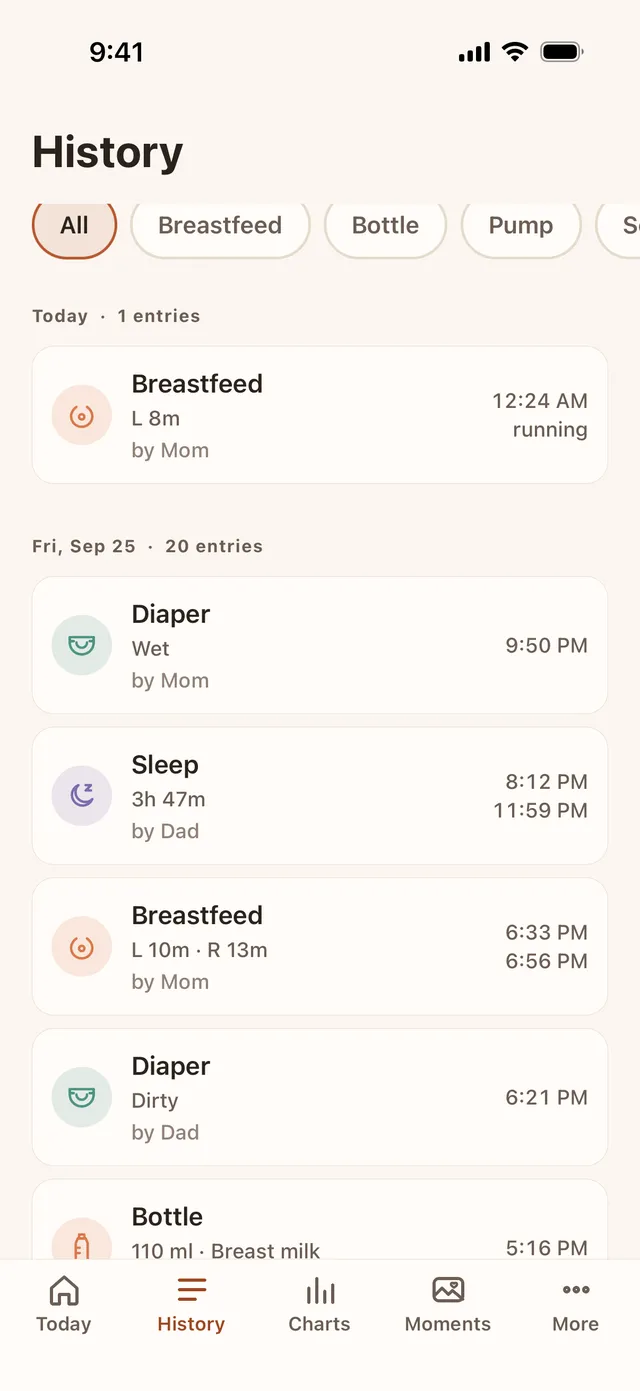
Baton has no early-waking tracker or sleep coach. It records what you enter and shows it back. Tap Sleep when your baby falls asleep and tap it again when they wake, or enter the times afterwards; if you forgot the timer, you can start it 5, 10, 15 or 30 minutes ago. Naps and the night all go into the same list, and each entry shows who logged it, so the person on the early shift and the person on the late shift write to one log.
In History, every sleep appears with its start and length in time order, with feeds and diapers around it, so you can see whether a 5am wake-up came with a feed and how the previous day's naps looked. Open Charts and choose Today to see that day's totals, including the longest sleep and the split between naps and night; Baton counts a sleep that starts between 19:00 and 05:59 as night sleep. Today and the last 7 days of charts are free; the 30- and 90-day trends are part of Baton Plus.
For anything that does not fit an entry, such as “woke at 5:10 hungry, drank 120 ml, back to sleep”, tap Note on the Today screen and write one line.
When should I talk to the doctor?
Mention it if your baby is unusually hard to wake, seems unwell or in pain when they wake, is feeding poorly, snores loudly or has pauses in breathing, or if your own exhaustion is affecting your health or mood. Bring the log: “woke before 5:30 on 9 of 14 days” is far easier to discuss than “he wakes up too early”.
If you think it is an emergency, call your emergency number straight away.
Frequently asked questions
- Why does my baby wake up at 5am?
- There is no single answer. Public sources mention body-clock development, daytime sleep, bedtime, light and, for younger babies, hunger. A log of wake times, naps and bedtime helps you and your pediatrician see which applies.
- Is it normal for a baby to wake early?
- NHS and NCT pages describe night waking and early waking as common in babies and young children. Ask your pediatrician or health visitor if you are worried.
- Does Baton fix early waking?
- No. Baton has no sleep coaching or early-waking feature. It records the sleeps, feeds and notes you enter and shows them in History and Charts.
- How long should I keep a log before changing anything?
- There is no official number. One to two weeks of notes usually shows whether early mornings follow a pattern, and then you can change one thing at a time. Check with your pediatrician first if your baby is young or feeds at night.