When do babies sleep through the night? How to see your baby's longest sleep
Published 20 October 2026 · Đào Văn Thương · 5 min read
“Is your baby sleeping through the night yet?” is the question every new parent gets. The honest answer is that the phrase means different things to different people, and that babies reach it at very different ages. What you can measure is simpler: how long is your baby's longest sleep, and is it getting longer over the weeks?
This guide explains what the phrase usually means, what public health sources say about night waking, and how to track the longest sleep with a pen or in Baton: Baby Tracker. It is general information, not medical advice: if you are worried about your baby's sleep, ask your doctor or health visitor.
This guide is general information, not medical advice. Follow what your doctor, midwife or health visitor told you, and call emergency services in an emergency.
What does “sleeping through the night” mean?
There is no single official definition. One commonly quoted one, used for example by the Sleep Foundation, is a stretch of about 6 hours without waking for a feed. Other families mean 8 hours, or “from bedtime until I have to get up”. Whichever you use, it is a convenient label, not a milestone your baby is late for.
That is why a number you can see in your own log is more useful than the phrase: “longest sleep last night: 4 hours 10 minutes” is a fact, and next week's number tells you whether it is changing.
At what age do babies sleep through?
Public guidance is cautious. The NHS says each baby has their own pattern of waking and sleeping, and it is unlikely to be the same as other babies you know. NHS trust pages written for parents say it is normal for babies to wake and feed through the night for at least the first year (Bedfordshire NHS children's health pages), and that by around 3 months a baby may sleep about 5 hours at a stretch, and by 5 months up to around 8 hours, with the longer stretches usually coming at night (Derbyshire Family Health Service). Treat those as typical ranges, not targets.
Newborns wake to feed around the clock, so very long stretches are not expected in the first weeks. If your baby is very sleepy and hard to wake for feeds, or you are worried about feeding or weight gain, call your doctor rather than waiting for the log.
How do I find my baby's longest sleep?
You only need two times per sleep, the same as any sleep log:
- 1Write down when your baby fell asleep at night.
- 2Write down when they woke, even if it was only for a feed. A quick wake-and-feed ends one sleep and starts the next.
- 3In the morning, look at the night's sleeps and circle the longest.
- 4Once a week, compare the circled numbers. A single bad night means little; the direction over a few weeks says more.
If you keep the log with a partner, agree who writes the times, or share one log, so the night's number is not split between two notebooks.
What helps babies tell night from day?
The NHS suggests keeping lights low and voices quiet at night, and not playing with your baby or changing them unless needed, so they gradually learn that night is for sleeping. It also advises that for at least the first 6 months your baby sleeps in the same room as you, day and night. For safe-sleep basics such as sleeping on the back on a firm, flat surface, see the NHS or AAP pages, or our guide on how much a newborn sleeps.
How do I track the longest sleep in Baton?
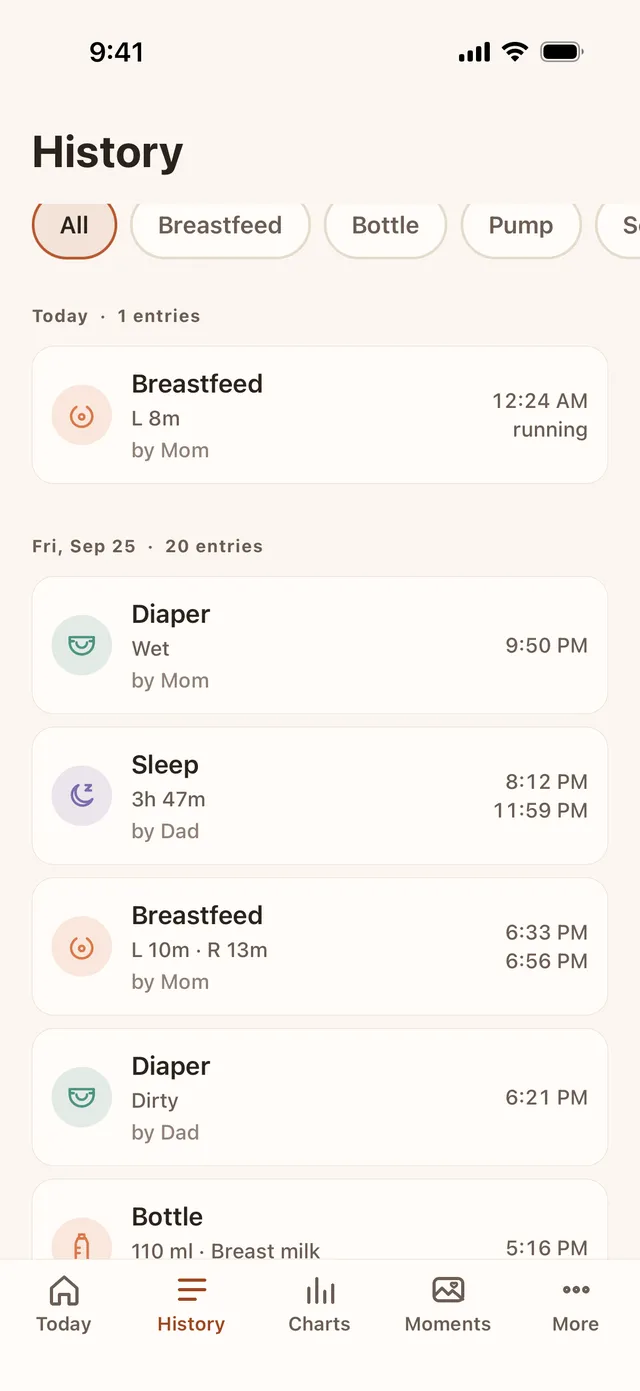
Tap Sleep when your baby falls asleep and tap it again when they wake, or enter the times afterwards. If you forget to start the timer, you can start it 5, 10, 15 or 30 minutes ago.
Open Charts and choose Today to see that day's tiles, including Longest sleep next to total sleep and the split between naps and night. Baton counts a sleep as night sleep if it started between 19:00 and 05:59. The Longest sleep tile shows the longest single sleep entry that started that day, so a sleep that began the evening before appears on the earlier day.
For the weekly view, open More and then Weekly summary. It shows this week's longest night next to the week before, as two plain numbers with no arrows, colours or score. “Longest night” there means the longest single sleep that began within the night hours set in Baton (the night-mode hours, 20:00 to 07:00 by default). On a Sunday it compares the week so far with the same stretch last week; on other days it compares the last full week with the one before. Monday to Sunday weeks.
All of this is free. Today and the last 7 days of charts are free; the 30- and 90-day trends are part of Baton Plus.
One tip: if your baby stirs but settles without a real wake-up, you do not need to stop the timer. If they fully wake, stop it and start a new sleep when they go back down, so the number matches what actually happened. Baton only records what you enter; it does not judge whether a number is good.
When should I talk to the doctor?
Mention it if your baby seems unusually hard to wake, seems to be in pain when they sleep, snores loudly or has pauses in breathing, is feeding poorly, or if the lack of sleep is affecting your own health or mood. Parents' exhaustion matters too: tell your health visitor or doctor. Bring the log, because it turns “he never sleeps” into numbers.
Frequently asked questions
- When do babies sleep through the night?
- There is no set age. NHS trust pages say it is normal to wake and feed through the night for at least the first year, and that by about 3 to 5 months a baby may manage longer night stretches of roughly 5 to 8 hours. Ask your doctor or health visitor if you are unsure.
- How many hours count as sleeping through the night?
- There is no official number. About 6 hours is one commonly quoted definition. Track your baby's longest sleep and its trend instead of chasing a number.
- Does Baton show my baby's longest sleep?
- Yes. Charts, Today shows a Longest sleep tile, and the Weekly summary shows the longest night this week next to last week. Both are free.
- Does Baton tell me if my baby sleeps enough?
- No. It records what you enter and shows it back. It does not diagnose or rate sleep, so ask your doctor if you are worried.
- Is a night wake-up a problem?
- Night waking is normal in the first year according to NHS sources. Call your doctor if your baby is unwell, hard to wake, feeding poorly or you are worried.