How to introduce a bottle to a breastfed baby: a simple log of every try
Published 22 October 2026 · Đào Văn Thương · 4 min read
Sooner or later most breastfeeding parents ask the same thing: when do we try a bottle, and what do we do when the baby refuses it? The honest answer is that babies differ, and the first tries often go badly even when everything is done right. What helps is calm, patience and a short record of what you tried, so that you are not guessing which attempt worked.
This guide summarises what the NHS says, then shows a small log to keep on paper or in Baton: Baby Tracker. It is general information, not medical advice: for timing, supply, or a baby who will not feed, ask your midwife, health visitor, doctor or a lactation consultant.
This guide is general information, not medical advice. Follow what your doctor, midwife or health visitor told you, and call emergency services in an emergency.
When do parents start offering a bottle?
The NHS mixed-feeding guidance suggests breastfeeding exclusively for about 6 to 8 weeks after the birth, to give you and your baby time to get the hang of it, and notes that introducing bottles can reduce the amount of milk you make because the gaps between breastfeeds get longer. Other sources say a few weeks, and the leaflets do not all agree.
So there is no single date. If you need to start earlier, for example for a return to work, ask your midwife or infant feeding team how to do it without affecting your supply.
What does the NHS suggest for the first bottle?
NHS pages on combining breast and bottle feeding suggest picking a calm moment rather than a time when the baby is tired or very hungry, letting someone other than the breastfeeding parent offer the first bottles, and using a slow-flow teat. They also suggest expressing milk between bottle feeds if you want to protect your supply.
Keep the bottle safe too: follow your bottle and sterilising instructions, and see our guide on preparing formula and keeping a bottle log if formula is part of the plan.
What should I write down?
A bottle trial is a handful of attempts over a couple of weeks. For each one, write down:
- The time, and how long since the last breastfeed.
- Who offered it, and where.
- What was in it: your expressed milk, formula or both.
- How much was offered and how much was taken.
- What happened: took it, fussed, turned away, or only took a little. A few words are enough.
After a week the log shows things you cannot remember otherwise, such as that the bottle goes better when your partner offers it, or in the afternoon rather than the evening. It also gives your health visitor or lactation consultant real information if the baby keeps refusing.
How do I log it in Baton?
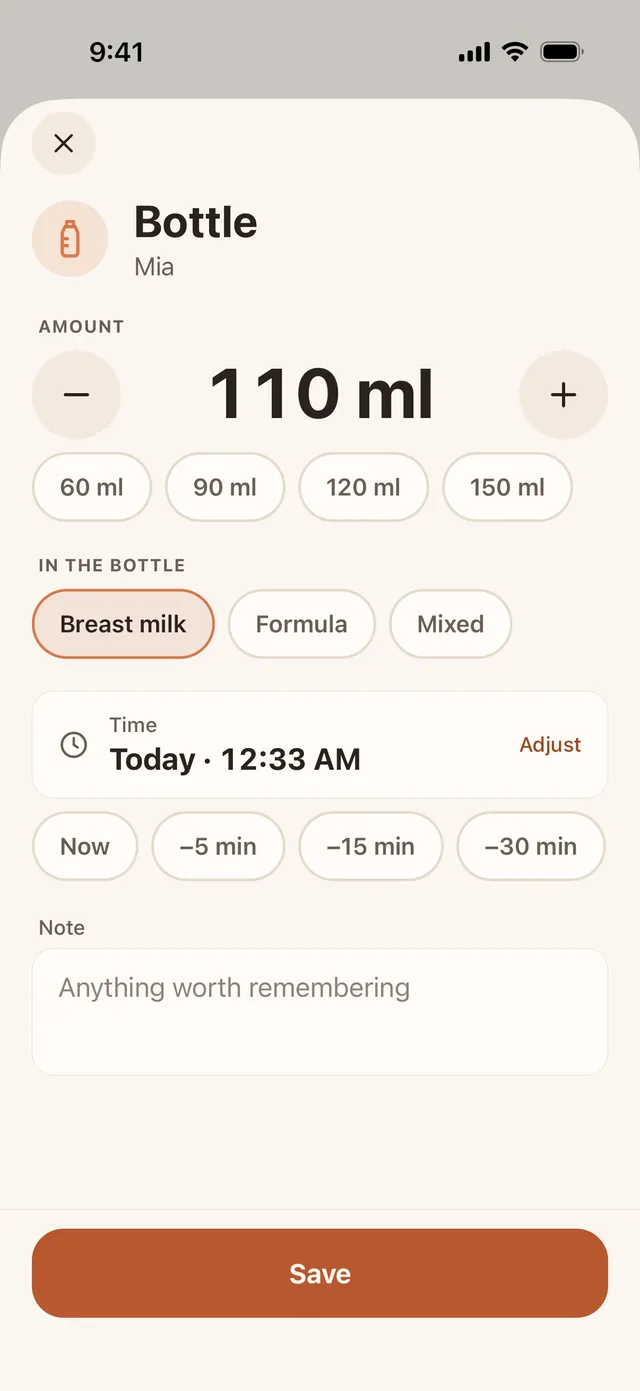
Tap Bottle, set the amount with the stepper or one of the preset buttons, choose what was in the bottle (Breast milk, Formula or Mixed), check the time and Save. Baton starts from the amount and content of your last bottle, so a repeat is quick. Every entry has an optional note: write “partner, slow-flow teat, took half” there. Baton also records which parent logged the entry, and the entry shows up on the other parent's phone through your own iCloud.
Baton needs an amount above zero to save a bottle. If the baby refused it entirely, add a Note entry instead (Baton has a free-text Note kind) with the time and what happened, so that the attempt is still on the record.
If you pump, log each session with Pump so that you can see how much milk you have next to what the baby takes. The Charts screen shows Bottles per day, split by breast milk, formula and mixed, and the 7 days view is free; 30- and 90-day trends are part of Baton Plus.
Baton only records what you enter. It does not say how much a baby should drink or whether a bottle trial is going well.
When should I ask for help?
Ask your midwife, health visitor, doctor or a lactation consultant if your baby refuses every bottle and you need to be away, if they take much less than usual over a day, if you notice fewer wet diapers than your care team expects, if your breasts are painful or your milk supply drops, or if feeding is not going well in any way. In an emergency, call your local emergency number. Bring the log: it shows what you tried and what happened.
Frequently asked questions
- When can I introduce a bottle to a breastfed baby?
- There is no single date. The NHS mixed-feeding guidance suggests breastfeeding exclusively for about 6 to 8 weeks after the birth, so that breastfeeding is well established, while other leaflets say a few weeks. Ask your midwife or health visitor what fits your situation.
- What does the NHS suggest for a first bottle?
- Choose a calm moment when the baby is not tired or very hungry, let another person offer it, and use a slow-flow teat. Expressing between bottle feeds can help protect supply. Ask your midwife or lactation consultant for advice that fits you.
- Can Baton log a bottle that my baby refused?
- Baton needs an amount above zero to save a Bottle, so for a refused bottle add a free-text Note entry with the time and what happened. A partial bottle can be logged with the amount actually taken and a note.
- Can my partner log bottles on their own phone?
- Yes. Both parents log to the same record through their own iCloud, and each entry shows who logged it.
- Does Baton tell me how much milk my baby should drink?
- No. It records what you enter and shows it back, with no targets or scores. Ask your doctor or health visitor how much your baby needs.