How to prepare formula safely and keep a bottle-feeding log
Published 1 October 2026 · Dao Van Thuong · 5 min read
Make each bottle fresh: clean hands, surface and bottle; boiled water that has cooled only a little (WHO says not below 70 °C); exactly the amount of powder on the tin; cool it quickly, check it on your wrist, and throw away whatever is not drunk within two hours. Then write one line in your log: the time, the amount and what was in the bottle.
How much and how often your baby should drink is for your doctor or health worker to tell you. This guide covers the safe preparation and the record-keeping.
This guide is general information, not medical advice. Follow what your doctor, midwife or health visitor told you, and call emergency services in an emergency.
Why does preparation matter so much?
Powdered infant formula is not a sterile product. The World Health Organization (WHO) explains that it can contain small numbers of harmful bacteria, such as Cronobacter sakazakii and Salmonella, and that newborns — especially babies born early, with a low birth weight or with weak immunity — are the most vulnerable. Correct preparation and handling greatly reduce that risk.
Getting the mixture right matters just as much. WHO's guidance is blunt: adding more or less powder than the label says could make a baby ill. Too much can be hard on a baby's body; too little leaves them underfed.
Ready-to-feed liquid formula is sterile until it is opened. If your baby was born early or is unwell, ask your care team whether they recommend it.
How do I make up a bottle of powdered formula?
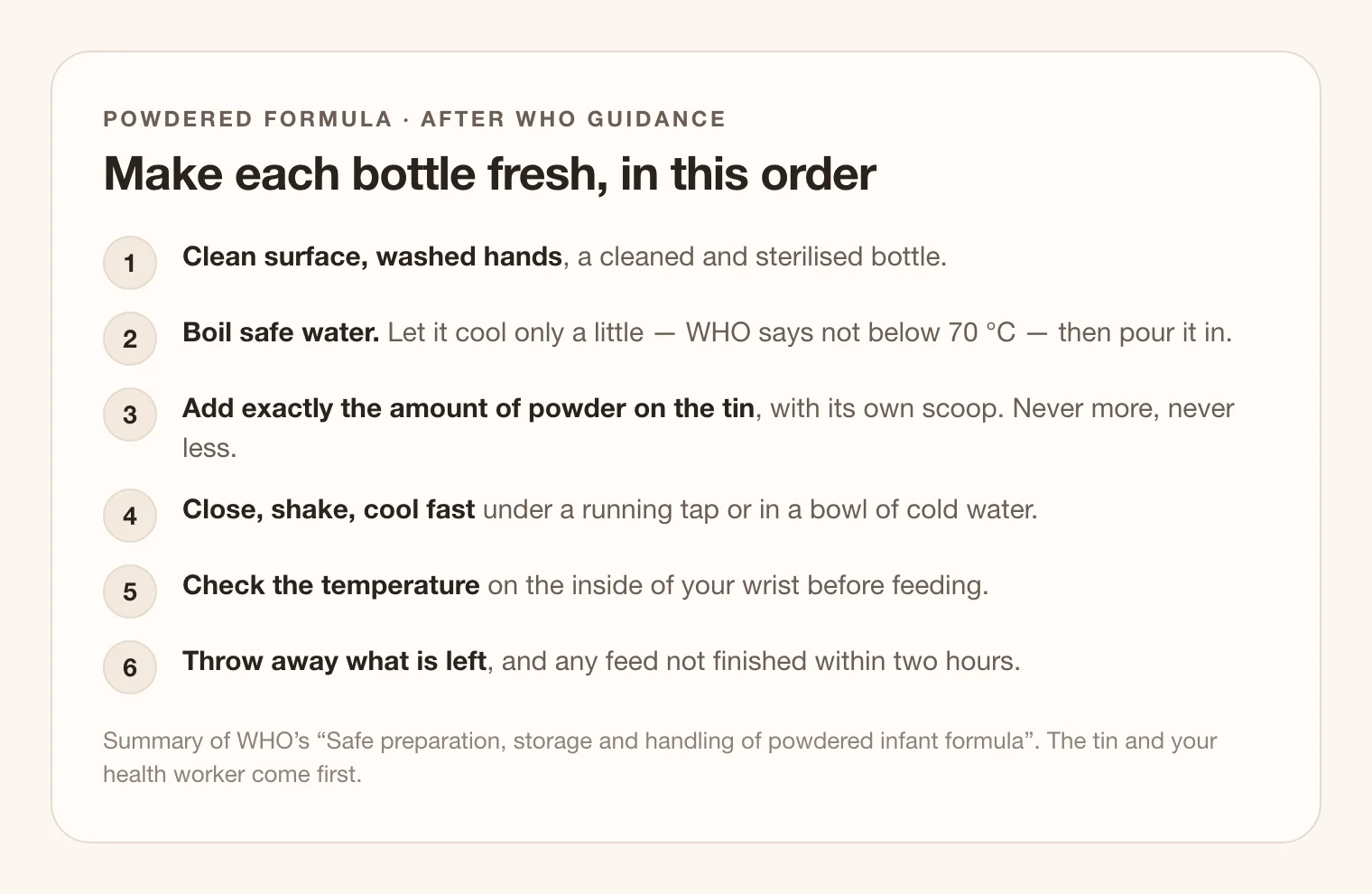
These steps summarise WHO's guidelines on the safe preparation, storage and handling of powdered infant formula. Your tin's own instructions and your health worker's advice come first.
- 1Clean the surface where you will prepare the feed, and wash your hands with soap and water.
- 2Use a bottle, teat and cap that have been cleaned and sterilised.
- 3Boil fresh, safe water. Bottled water is not sterile either and needs boiling too. Never use a microwave to heat water or feeds: it heats unevenly and can scald.
- 4Let the water cool only slightly — WHO says to use water no cooler than 70 °C — and pour the amount the tin tells you into the bottle, taking care not to scald yourself.
- 5Add exactly the number of level scoops the tin says, using the scoop that came with it. Never add extra powder or extra water.
- 6Close the bottle and shake or swirl until fully mixed.
- 7Cool it quickly to feeding temperature under a running cold tap or in a bowl of cold water, keeping the water below the cap.
- 8Check the temperature by shaking a few drops onto the inside of your wrist. It should feel warm, not hot.
- 9Throw away any formula your baby has not drunk within two hours.
Can I make bottles in advance?
WHO's advice is that it is best to prepare each feed fresh and give it straight away. If you do need to prepare feeds ahead — for a night out or a long day — WHO says to cool them quickly and keep them in the fridge, use them within 24 hours, and still throw away anything not drunk within two hours of taking it out and warming it.
A half-finished bottle should never go back in the fridge for later. Bacteria from your baby's mouth get into the milk during a feed.
For outings, many parents carry the measured powder in a clean, dry container and a flask of hot boiled water, then make the bottle up when it is needed. Ask your health worker what they suggest for your situation.
What should a bottle log include?
A bottle log answers the questions your doctor or health worker asks most often. One line per bottle:
- Start time.
- Amount drunk — the amount offered minus what was left. If you only note one number, note what your baby actually took.
- What was in it: formula, expressed breast milk, or a mix.
- Who gave it, if more than one person feeds the baby.
- A short note when something is different: spat up a lot, very slow, refused, new tin or new brand.
Add up the day's bottles once, in daylight. If you are combining breastfeeding and bottles, keep both in the same log so the whole day is in one place.
How do two people share the log?
Bottle feeding often means several people feed the baby — a partner, grandparents, a nanny. The log only works if everyone writes in the same place.
On paper, keep one sheet by the kettle or the bottle station, with a pen tied to it. On the phone, use one shared note or spreadsheet rather than messaging each other; messages scroll away, a shared list does not.
Agree on units too. If one person writes ml and another oz, the totals will be wrong. Pick one and write it at the top of the page.
When should I ask for help?
Talk to your doctor or health worker if your baby often refuses bottles, vomits forcefully, has far fewer wet diapers than usual, seems to struggle or tire during feeds, or if you are unsure which formula to use or how much to offer. Do not change the ratio of powder to water to try to fix a problem.
Call emergency services if your baby has trouble breathing, becomes floppy or unresponsive, or seems seriously unwell.
Where Baton helps
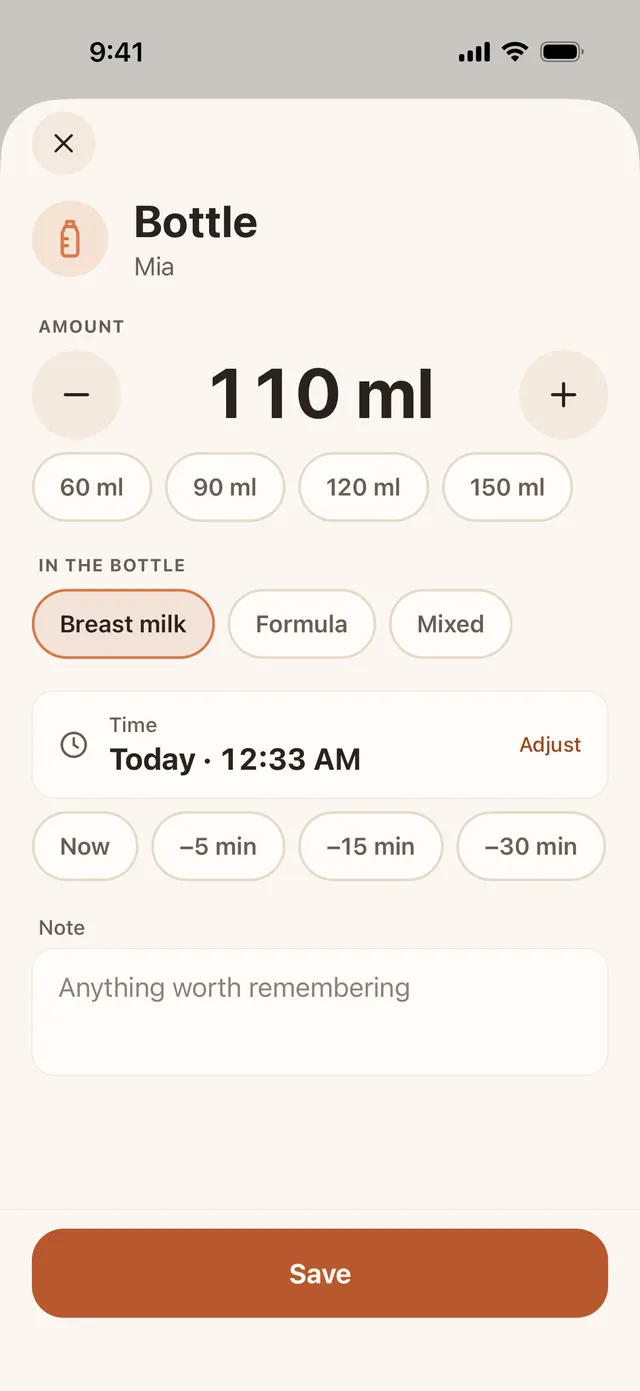
In Baton, Bottle is one of the big buttons on Today. The sheet takes the amount in ml or oz, with quick amounts to tap, and what was in the bottle: Breast milk, Formula or Mixed. The time defaults to now and moves back by 5, 15 or 30 minutes with one tap if you log after the feed.
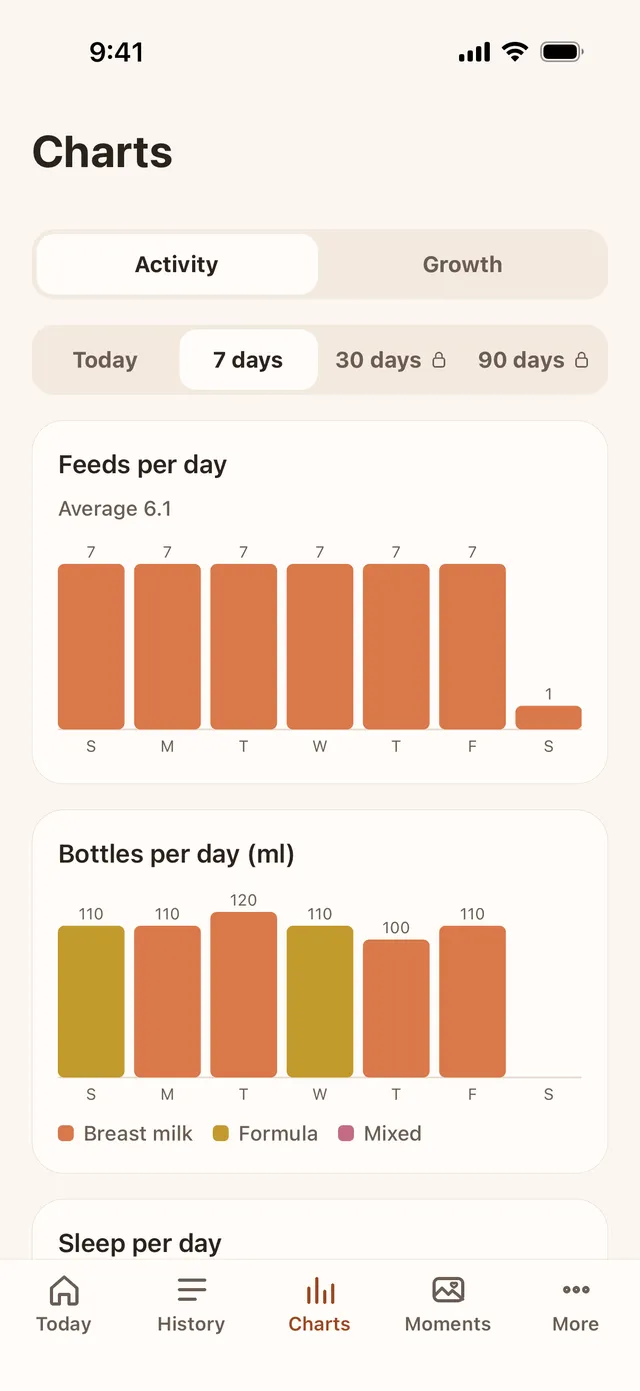
The 7-day charts show bottles per day, coloured by what was in them, next to feeds per day. Both parents log into the same history through their own iCloud, so the bottle given at 3 AM is already on the other phone, and a grandparent or nanny can be invited with view-only access. Siri can log a bottle by voice, and the CSV export is free.
Baton never tells you how much your baby should drink. It is coming soon to the App Store for iPhone and iPad, with no account, no ads and no analytics.