Baby crying a lot: how to keep a simple crying log and tell colic from something else
Published 7 November 2026 · Đào Văn Thương · 4 min read
“Why is my baby crying all evening, and is it colic?” is a question parents type in with a baby on their shoulder and no idea how long this will last. Public health sources describe colic as common and usually harmless, and they also list signs that need a call. A few days of notes helps you see the pattern, and gives your health visitor or pediatrician more to work with than “he cries a lot”.
This guide explains what NHS pages say, what is worth writing down, and how to keep that record on paper or in Baton: Baby Tracker. It is general information, not medical advice. Why your baby is crying is a question for your pediatrician, midwife or health visitor.
This guide is general information, not medical advice. Follow what your doctor, midwife or health visitor told you, and call emergency services in an emergency.
What do NHS pages say about colic?
The NHS describes colic as a baby crying a lot for no obvious reason, and says it usually gets better by about 3 or 4 months. NHS 111 Wales describes it as a baby who is otherwise healthy crying for more than 3 hours a day, on 3 days a week, for at least a week. Wording differs between NHS pages, so check the page itself for the current text. Colic is not usually harmful, and your baby should keep feeding and gaining weight.
The same pages say to call NHS 111 or see your GP if you are worried, if nothing seems to be working, or if your baby is not gaining weight as expected. They say to go to A&E or call 999 if your baby has a weak or high-pitched cry, or a cry that does not sound like their normal cry. In the UK, the Cry-sis helpline (0800 448 0737) supports parents of crying babies. Elsewhere, ask your doctor for a local number.
Why does a crying log help?
Crying always feels endless at the time. A log turns the evening into numbers: when it starts, how long it lasts, what helped. That lets you see whether there is a pattern (many babies are fussiest in the evening), whether it is getting better or worse, and whether it comes with something else, such as a feeding problem or a fever.
It also gives your care team something concrete. “Cries for about two hours every evening from 6 PM, settles after a feed, feeding and diapers normal” is easier for a nurse or doctor to act on than “he cries all the time”.
What should I write down?
Keep it short. You are doing it one-handed:
- When it started and roughly when it stopped (you can fill in the end afterwards).
- What was going on before: the time since the last feed, and whether your baby had just woken up.
- What helped, even a little: a feed, a diaper change, holding, a walk, white noise, a bath. Also write down what did not.
- How your baby looked in between: settled and feeding normally, or unwell in any way.
- Anything unusual, written plainly: a fever reading, vomit, fewer wet diapers, a feed refused, or a cry that sounds different from usual.
The feeds and diapers you already log are the context your care team asks about. Our guide on spit-up covers the vomiting side, and the sick-day guide covers temperature notes.
How do I keep a crying log in Baton?
Baton has no crying or colic button, and it does not detect or judge crying. It does have a Note: tap Note on the Today screen, write one line such as “fussy 6:15 to 8 PM, settled after a feed and a walk”, and save. Every entry has an editable time and shows who logged it, so a note you add after the fact can carry the right start time, and your partner's notes join yours.
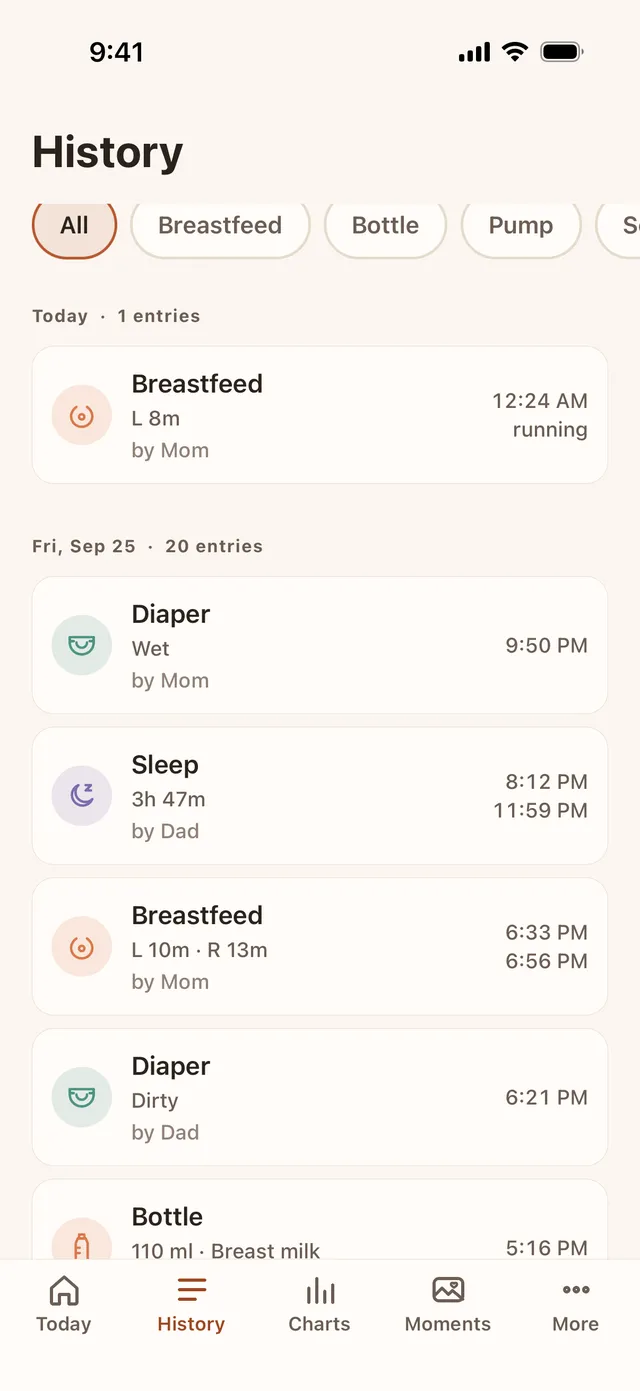
In History, notes sit in time order among your feeds, sleeps and diapers, so you can scroll back over a few evenings and read the crying next to what came before it. You can also add a short note to the feed or diaper entry it followed. Entries sync through each parent's own iCloud, and CSV export is free and has a note column, so you can search your notes in a spreadsheet. For an appointment, show the History screen or send the CSV.
When should I not wait for the log?
Do not wait to finish a log if your baby's cry sounds weak, high-pitched or different from normal, if your baby has a fever, is hard to wake, floppy, pale or breathing fast, is feeding poorly or has fewer wet diapers, vomits green or bloody fluid, has a swollen tummy, or if you simply feel something is wrong. Call your doctor or NHS 111 (or your local equivalent) at once, and call your emergency number if your baby is struggling to breathe or is hard to wake.
Looking after yourself counts too. Long crying spells wear parents down. If you reach the end of your patience, put your baby down somewhere safe, step away for a few minutes or hand over to your partner or someone you trust, and tell your doctor or health visitor how you are coping.
Frequently asked questions
- How long does colic last?
- The NHS says colic usually gets better by about 3 or 4 months. Ask your pediatrician, midwife or health visitor if it lasts longer or you are worried.
- How much crying is colic?
- NHS 111 Wales describes colic as an otherwise healthy baby crying for more than 3 hours a day, on 3 days a week, for at least a week. Only a doctor can tell you whether your baby has colic or something else.
- What should I write in a crying log?
- When the crying started and stopped, what came before it (the last feed, waking up), what helped, how your baby was in between, and anything unusual such as a fever, vomiting or a different-sounding cry.
- Does Baton have a colic or crying tracker?
- No. Baton has no crying button and gives no assessment. You can add a Note, read it in History next to your feeds, sleeps and diapers, and export it in the free CSV.