How to keep a food diary when your baby starts solids (new foods and reactions)
Published 1 October 2026 · Dao Van Thuong · 5 min read
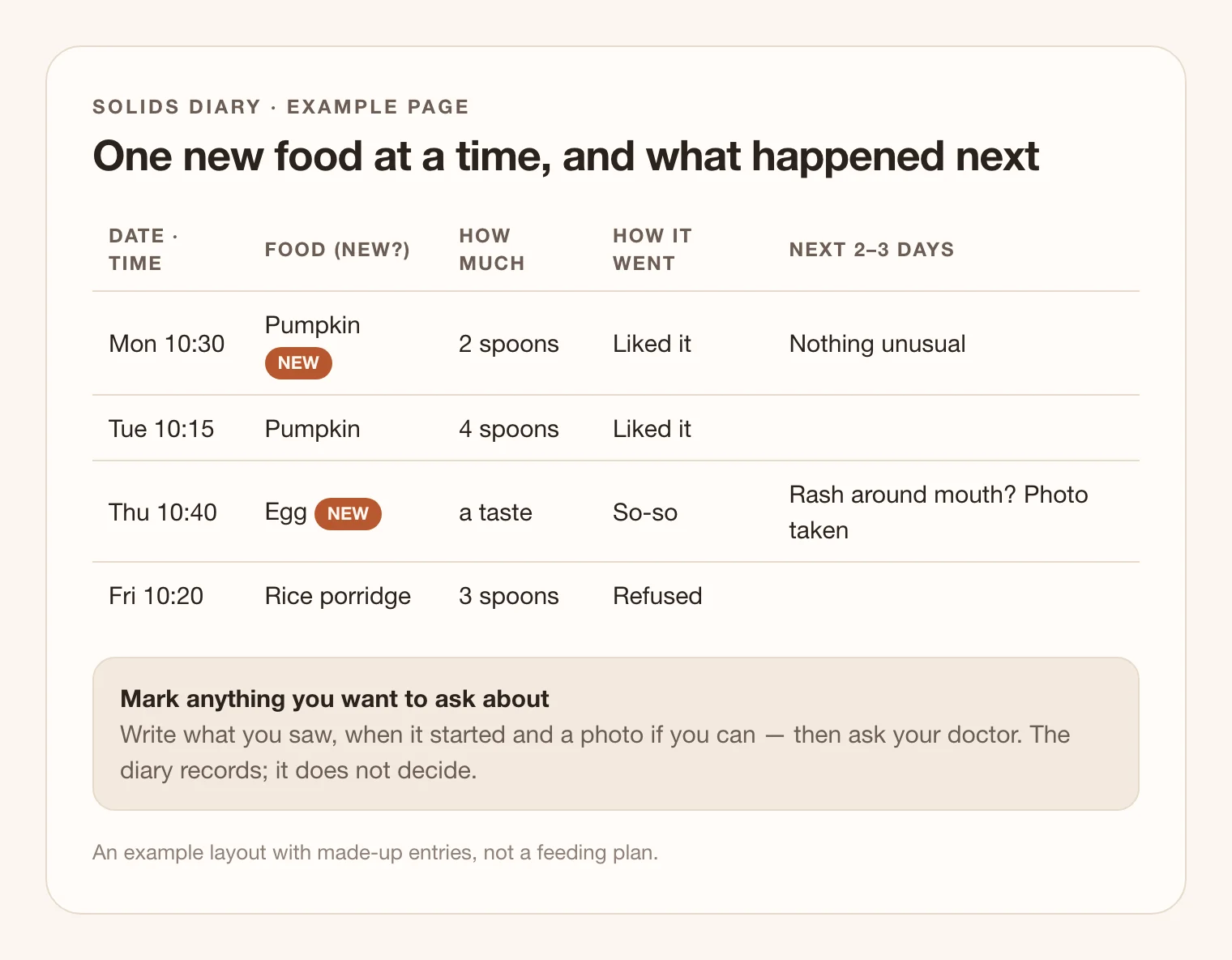
A solids diary is one line per meal: the date and time, the food, whether it was new, roughly how much, how it went, and anything you noticed in the following days. Offer one new single-ingredient food at a time, so that if something happens you know which food to mention to your doctor.
This guide covers what WHO and the American Academy of Pediatrics (AAP) say about starting, a page layout you can copy, and the reactions that mean you should stop and call rather than keep writing.
This guide is general information, not medical advice. Follow what your doctor, midwife or health visitor told you, and call emergency services in an emergency.
When do babies usually start solids?
WHO recommends exclusive breastfeeding for about the first six months, then adding safe, nutritious complementary foods while breastfeeding continues. The AAP gives the same broad picture: around six months, when your baby shows signs of being ready.
Readiness signs that public guidance describes include sitting up with good head control, showing interest in food, opening the mouth when a spoon comes near and being able to move food to the back of the mouth instead of pushing it out. Babies born early, or with feeding or medical issues, may follow a different plan — your doctor or health worker will tell you when and how to start.
The diary does not decide any of this. It starts on the day you start.
Why keep a diary at all?
- It tells you which food came right before a rash, a tummy upset or a refusal, instead of guessing after the fact.
- It shows what your baby has already tried, so the menu does not shrink to the same three purées.
- It gives your doctor dates and details. “Egg on Thursday, red patches around the mouth about twenty minutes later, photo here” is far more useful than “I think she reacted to something last week”.
- When two people feed the baby, nobody has to wonder whether the new food was already offered today.
What should I write down for each meal?
Keep it short enough to fill in with one hand while the other holds a spoon:
- 1Date and time — the time matters if a reaction appears, because you will want to know how long after the meal it started.
- 2The food, and whether it is new. A star or the word NEW next to first tastes makes them easy to spot later.
- 3Roughly how much — “a taste”, “two spoons”, “half the bowl”. No need to weigh anything.
- 4How it went — liked it, so-so, or refused. Refusals are normal and worth noting so you try again on another day rather than drop the food for good.
- 5Anything you noticed afterwards — skin, tummy, diapers, sleep, mood — with the time it started.
If a food has more than one ingredient, write the ingredients, not the recipe name. “Porridge with pumpkin and a little butter” tells you more than “orange porridge”.
How long should I wait between new foods?
The AAP suggests introducing one single-ingredient new food every three to five days and watching for any reaction. Mixing foods your baby has already eaten without problems is fine; it is the new ones you space out.
The AAP also says there is no evidence that waiting beyond four to six months to introduce foods such as egg, dairy, soy, peanut products or fish prevents food allergy. For babies with severe eczema or an egg allergy, it recommends talking to the doctor first about how and when to give peanut products. If either applies to your baby, ask before you plan the next new food.
Always give foods in a texture that is safe for your baby's age — your health worker can tell you what that means for whole nuts, round foods and anything hard.
Which reactions should I write down?
Write down what you see, in plain words, with the time — not what you think it is. Things parents commonly note include:
- Skin: redness or a rash around the mouth or elsewhere, hives, swelling.
- Tummy: vomiting, a lot more spitting up than usual, diarrhoea or a clear change in the diapers.
- Mood and sleep: unusual crying or fussiness after eating.
A photo of a rash or a diaper, taken near a window, is often more useful to a doctor than any description. Note the time on the photo or in the diary next to it.
When should I stop writing and call for help?
Call emergency services straight away if, after eating, your baby has trouble breathing, wheezes, has swelling of the lips, tongue or face, vomits repeatedly, becomes floppy or very pale, or seems suddenly unwell. Do not wait to see whether it passes and do not finish the diary first.
For milder things — a small rash, one loose diaper, a food your baby keeps refusing — note it and talk to your doctor or health worker before offering that food again. They decide whether it was a reaction and what to do next; the diary simply gives them the facts.
Can I keep the diary without an app?
Yes. A notebook page with the five columns above works well, kept near the high chair with a pen clipped to it. Rule a line under each new food so the three-to-five-day watching window is visible at a glance.
On the phone, one running note in the Notes app works too: start each line with the date and time, type NEW in capitals for first tastes, and put photos straight into the note. Share the note with your partner so you both write in the same place.
Where Baton helps
Solids is one of the big buttons on Baton's Today screen. A meal takes the food (with chips for the foods you have logged recently), the time, which you can change, and “How it went”: Liked it, So-so or Refused. There is also an “Allergy suspicion” flag — a flag for your records and your doctor that Baton does not interpret.
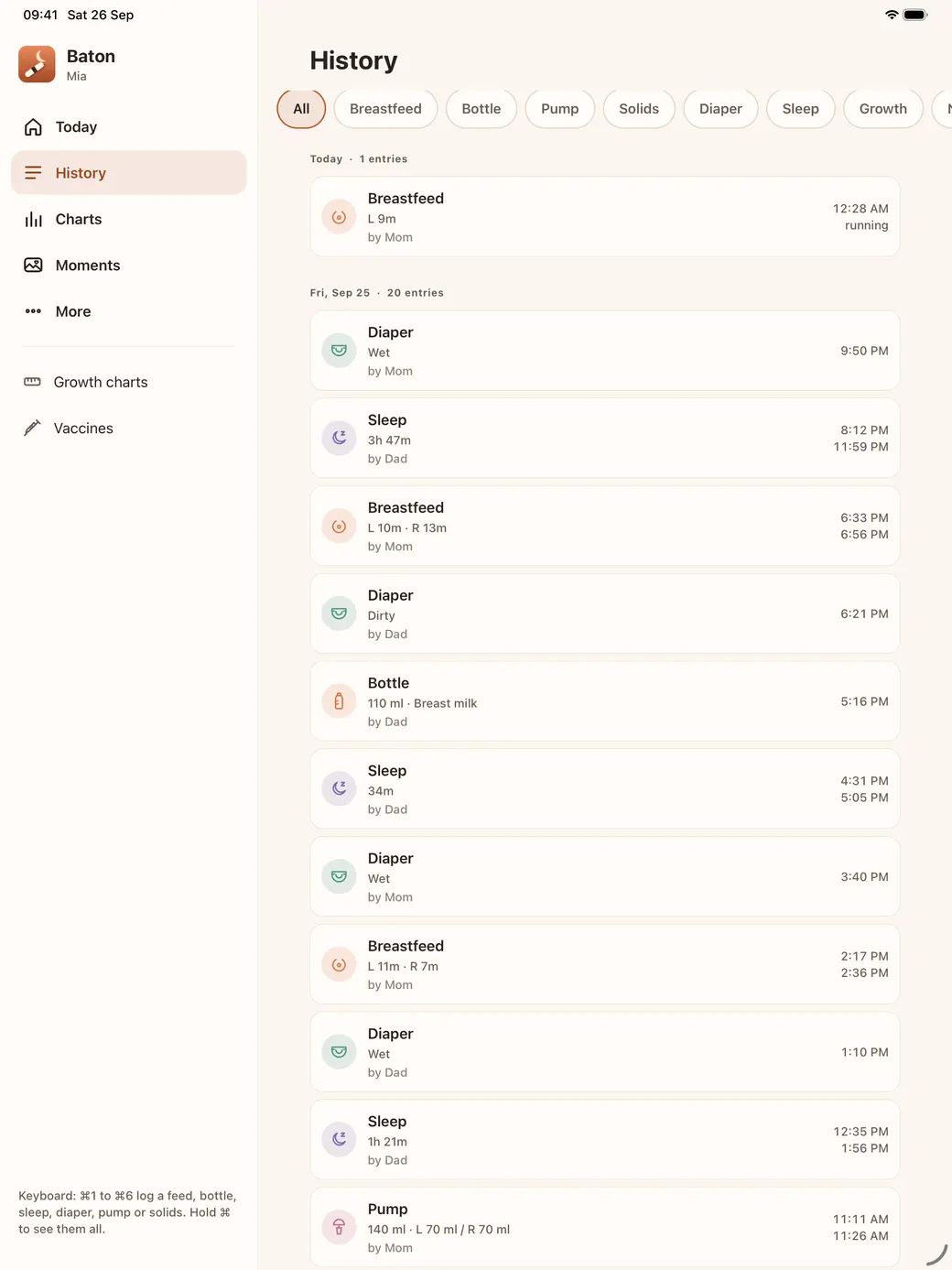
History has a Solids filter, so every food your baby has tried is one tap away, next to the feeds, sleep and diapers of the same days. Both parents log into the same history through their own iCloud, the CSV export is free, and the optional PDF report for the pediatrician is part of Baton Plus.
Baton is coming soon to the App Store for iPhone and iPad. It has no account, no ads and no analytics, and it never tells you what a reaction means — that stays with your doctor.