Newborn poop colours: how to write them down and when to call the doctor
Published 1 October 2026 · Dao Van Thuong · 5 min read
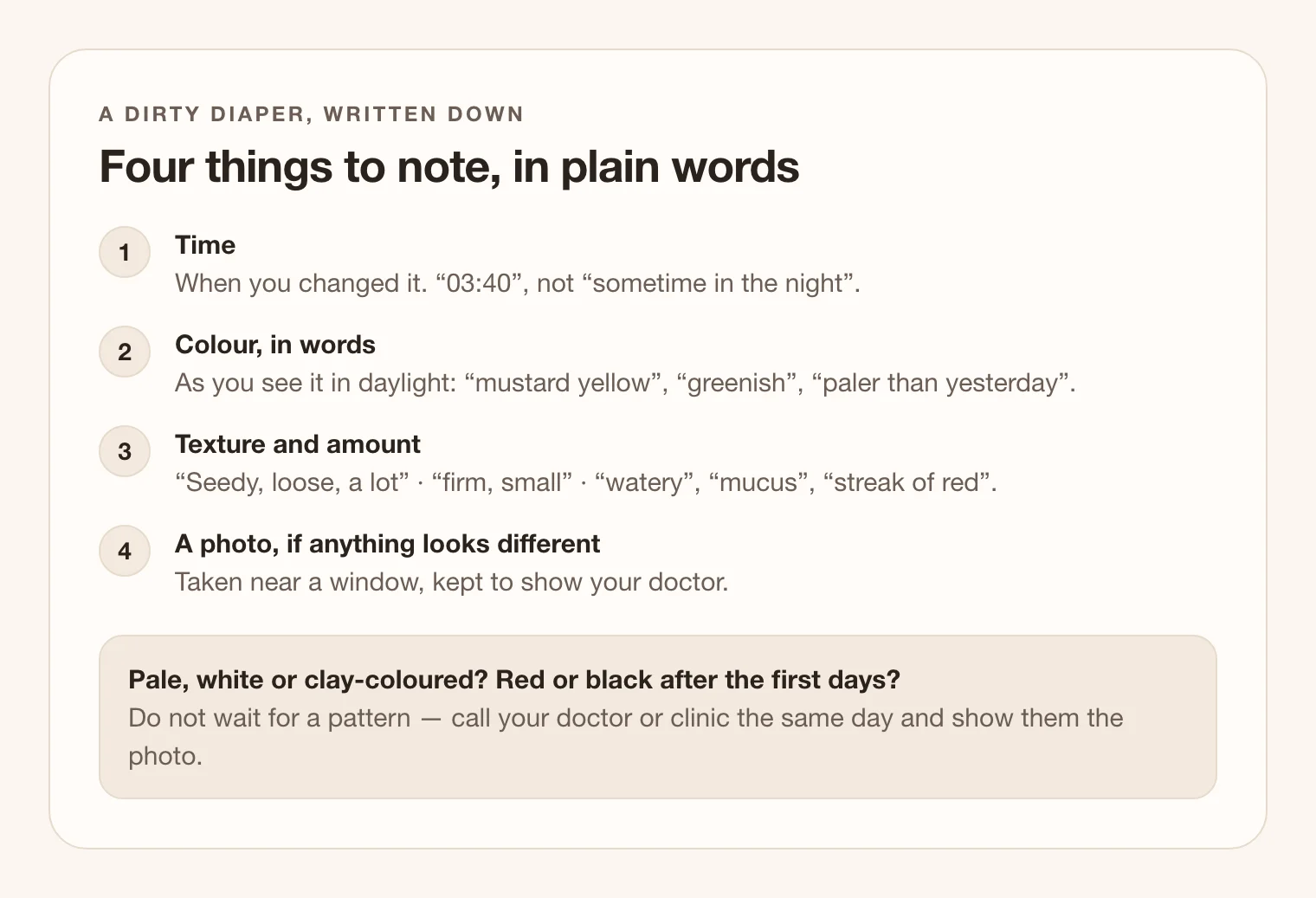
Newborn poop changes a lot in the first weeks, and a wide range of yellows, greens and browns is common. What matters is noting it the same way each time — the time, the colour in plain words, the texture and a photo if anything looks different — and calling your doctor the same day for pale, white or clay-coloured stools, or for red or black ones after the first few days.
This guide is about recording what you see so your care team can judge it. It does not tell you what a colour means; only someone who examines your baby can do that.
This guide is general information, not medical advice. Follow what your doctor, midwife or health visitor told you, and call emergency services in an emergency.
How does newborn poop usually change?
The first stools, called meconium, are thick, sticky and very dark — black or dark green. Over the following days they usually become lighter and looser as milk comes in. Breastfed babies' stools are often described as mustard yellow, soft and seedy; formula-fed babies' are often a little firmer and tan, yellow or brownish. Green shades are common too.
How often babies poop also varies widely, especially once breastfeeding is established. Your doctor, midwife or health visitor will tell you what they want to see at your baby's age, and diaper counts in the first week are part of how they judge feeding — see our guide on knowing whether your baby is getting enough milk.
Because the normal range is wide, a single unusual diaper is often less important than a change that continues, or a colour from the short list below.
Which colours mean calling the doctor the same day?
Public health guidance and children's hospitals single out a few colours that should never wait for the next routine check:
- Pale, white, chalky, grey or clay-coloured stools, or a very pale yellow — especially if your baby's skin or eyes are yellow or the urine is dark. These can be a sign of a liver problem such as biliary atresia, which is time-sensitive to treat. Several countries, including Japan and Taiwan, give parents a stool colour card to compare against in the first months; if your hospital gave you one, keep it with your log.
- Red streaks or blood, or black stools after the meconium has passed.
If you see any of these, call your doctor or clinic that day and show them a photo. Do not wait to see whether the next diaper is different. If your baby also seems unwell — very sleepy, floppy, feeding poorly, or has trouble breathing — call emergency services.
How do I describe a colour in words?
Colour on a diaper is hard to judge at night and easy to remember wrongly. A few habits make your notes reliable:
- 1Look in daylight or under a normal white light, not a dim yellow night light.
- 2Use everyday comparisons that anyone would understand: “mustard”, “pale yellow like butter”, “dark green”, “light brown”, “paler than yesterday”.
- 3Write what you see, not what you think it means. “Greyish, almost white” is useful; “looks fine” is not.
- 4Add the texture: seedy, soft, runny, watery, firm, pellets, with mucus.
- 5Note roughly how much, and anything else you noticed — a red streak, a smell that is very different, or a diaper that is wet only.
Should I take photos of diapers?
Yes, if anything looks different. A photo is far more accurate than a description, and doctors and nurses are used to being shown them. Take it near a window or under white light, without a filter, and include a corner of the white diaper for reference.
Keep these photos in a separate album so they do not end up in a family slideshow, and delete them once they have served their purpose. Note the time of the photo in your log so you can match it to the feed before.
How do I log diapers on paper?
Add a diaper column to your feeding log, or keep a separate list if that is easier. One line per change:
- Time.
- W for wet, D for dirty, WD for both.
- For dirty diapers: colour in words, texture, and “photo” if you took one.
At the end of the day, count wet and dirty diapers. In the first week this daily count is often what the midwife or doctor asks for first, and the colour notes are what they ask next.
If two people change diapers, keep one list in one place — a sheet on the changing table, or one shared note on your phones — so nothing is counted twice or missed.
What else should I tell the doctor?
Colour is only one piece. When you call, it helps to have:
- When the change started and whether it has continued.
- How feeding is going, and the recent diaper counts.
- Whether the skin or the whites of the eyes look yellow, and whether the urine is pale or dark.
- Any medicines or vitamins your baby is taking, and any new foods if your baby has started solids.
- Your photos.
Trust your instinct. You do not need a perfect log to call; you need to call when something seems wrong.
Where Baton helps
In Baton, a diaper is one tap: Wet, Dirty or Both. A long press adds an optional colour — yellow, mustard, green, brown, black, red, or pale or white — and lets you change the time. The colour is recorded as-is so you can show your doctor; Baton does not interpret colours and never tells you whether a diaper is normal.
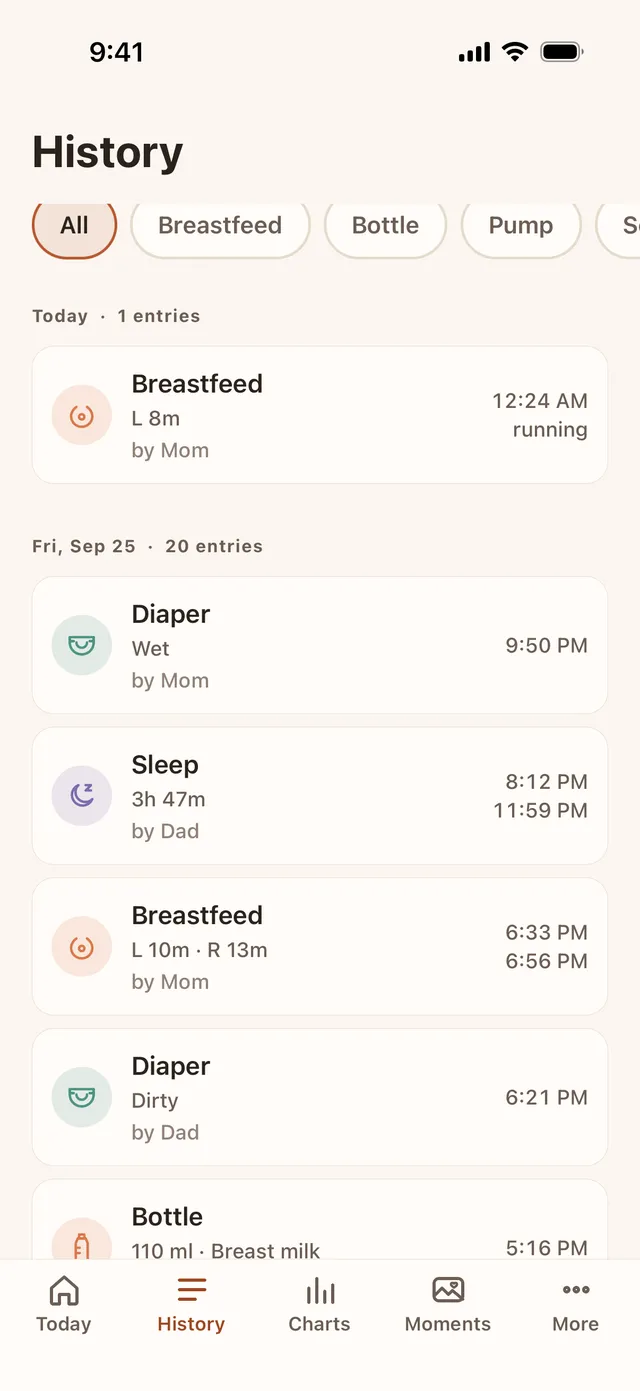
History lists every diaper with its time and who logged it, the 7-day charts count wet and dirty diapers per day, and both parents log into the same history through their own iCloud, so a change at 3 AM is already on the other phone. The CSV export is free.
Baton is coming soon to the App Store for iPhone and iPad, with no account, no ads and no analytics. Baton does not attach photos to diapers, so keep any photo for the doctor in your phone's Photos app.