How to keep a medicine and temperature log when your baby is sick
Published 1 October 2026 · Dao Van Thuong · 5 min read
When your baby is sick, write one line for every temperature reading, every medicine and every new symptom: the time, what it was, the details exactly as measured or as written on the label, and who did it. Before anyone gives a medicine, they read the last line first — that single habit is what stops a double dose between two tired caregivers.
The log is a record, not a guide. The medicine, the dose, the gap between doses and when to call all come from your doctor or pharmacist.
This guide is general information, not medical advice. Follow what your doctor, midwife or health visitor told you, and call emergency services in an emergency.
Why write it down when you will remember?
Because you will not, at least not reliably. A sick baby means broken nights, two people taking turns and calls to the doctor where you are asked very specific questions: when did the fever start, what was the highest reading, what have you given and when, is your baby feeding and wetting diapers?
- A written log answers those questions in seconds.
- It shows the direction of travel — better, the same, or worse — over a day or two, which is hard to judge from memory.
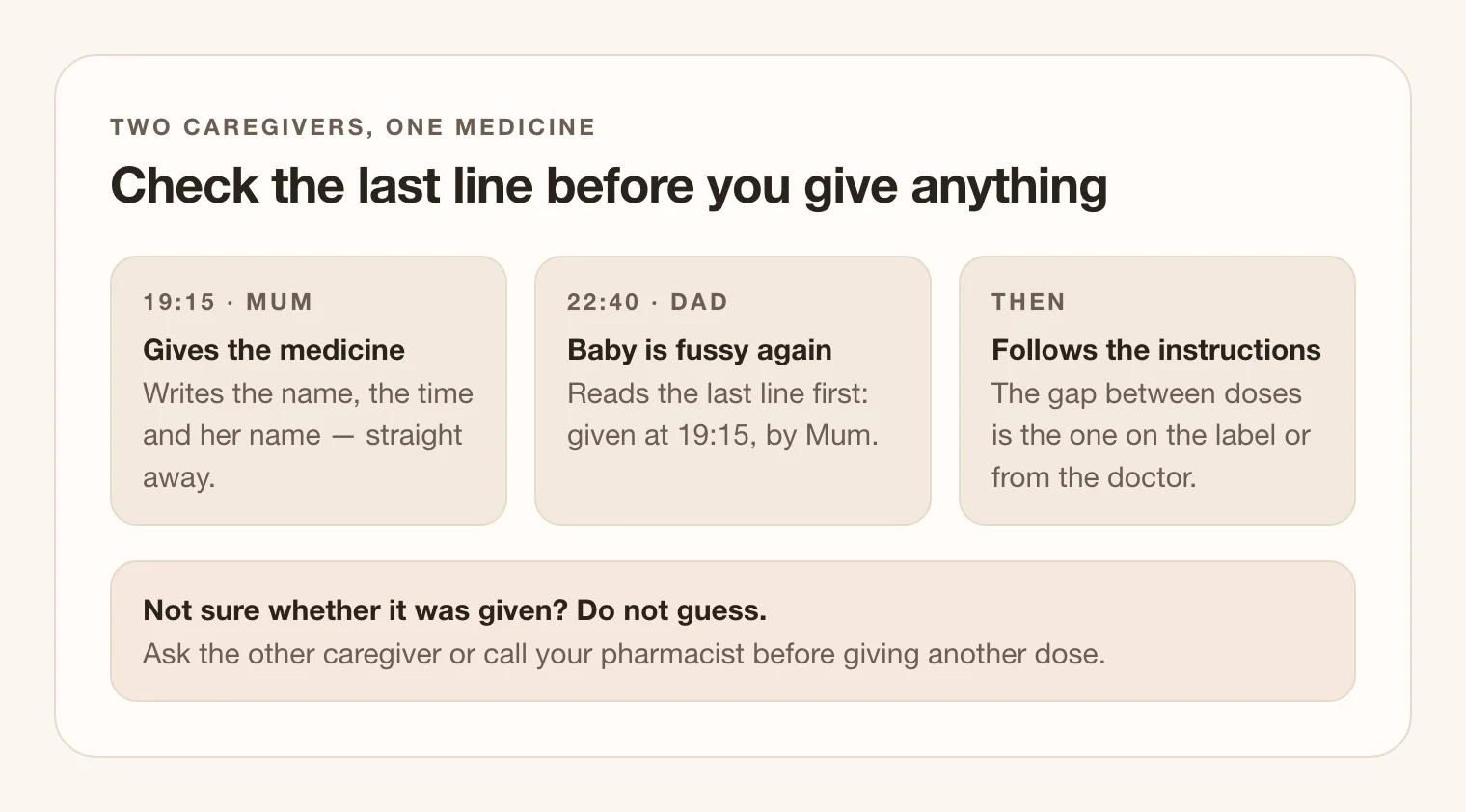
- Above all, it stops the most common home medicine mistake between two caregivers: both giving the same medicine because each thought the other had not.
What should I write down?
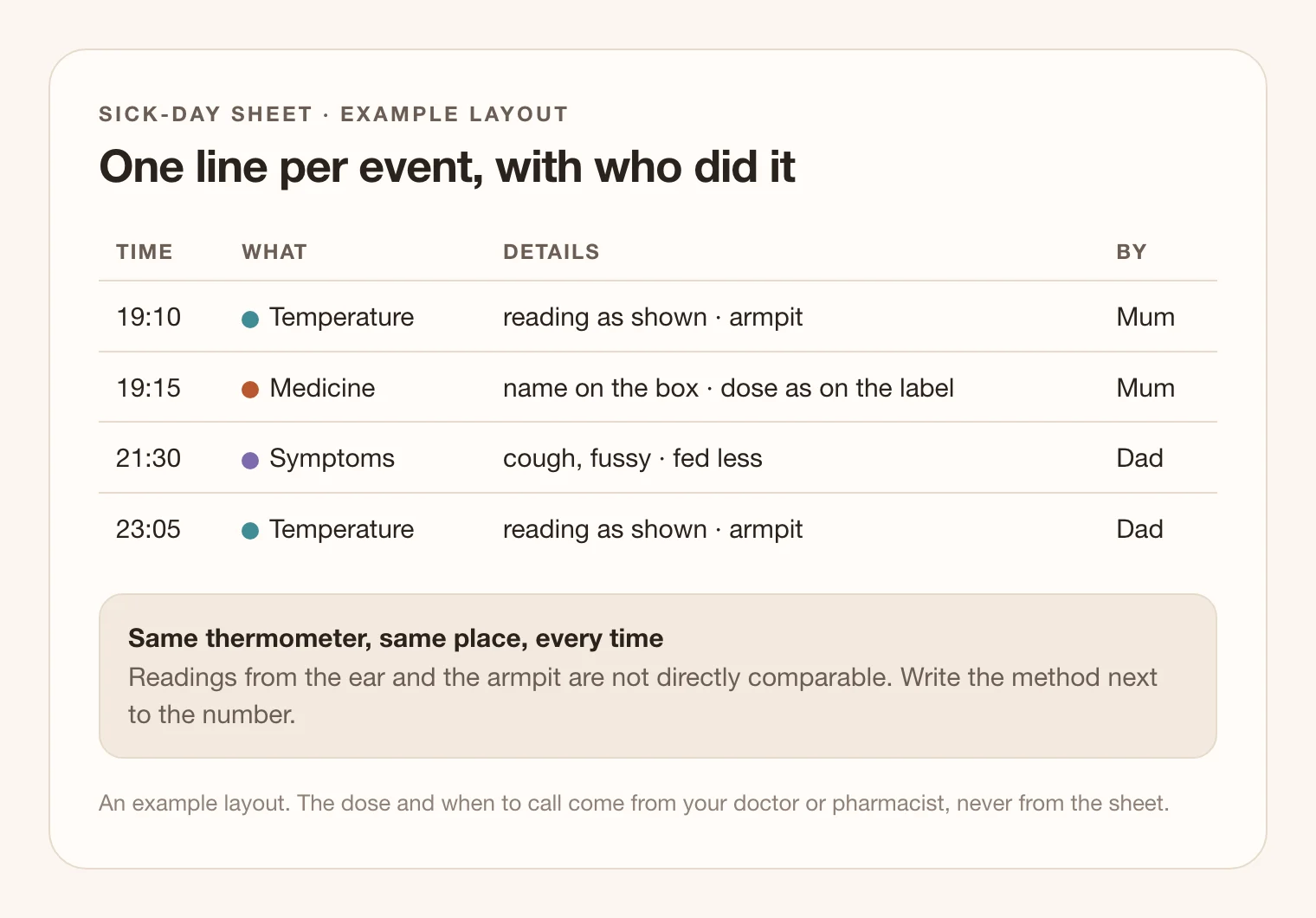
One line per event, always with the time and the person:
- Temperature: the reading exactly as the thermometer shows it, and where it was taken — armpit, ear, forehead, mouth or rectal. Readings taken in different places are not directly comparable, so the method belongs next to the number.
- Medicine: the name as it appears on the box or prescription, the dose exactly as written on the label or prescription, the time given, and who gave it. Never write a dose you worked out yourself.
- Symptoms: what you see, in plain words — cough, runny or stuffy nose, vomiting, diarrhoea, rash, unusual fussiness, refusing feeds.
- Feeds and wet diapers: when babies are unwell, doctors often ask how they are drinking and how many wet diapers there have been. Keep your usual feeding log going alongside.
How do I measure temperature consistently?
Ask your doctor or pharmacist which method they want you to use for your baby's age, and stick to it. Then:
- 1Use the same thermometer each time, and read its instructions once — some need a few seconds of stillness, some need a fresh cover.
- 2Take it in the same place each time, and write that place down.
- 3Wait a little after a bath, a feed or being wrapped up warmly, which can change the reading.
- 4Write the number immediately, before you put the thermometer away.
The reading tells your care team something; it is not a diagnosis on its own. How your baby looks, feeds and responds matters as much.
When should I call the doctor about a fever?
Your doctor will tell you when to call for your baby, and it is worth asking at a routine visit before anyone is sick. One rule is widely published: the American Academy of Pediatrics (AAP) advises calling your child's doctor right away if a baby younger than 3 months (12 weeks) has a temperature of 100.4°F (38.0°C) or higher.
Whatever the reading, call your doctor if your baby is feeding much less, has far fewer wet diapers, is unusually sleepy or hard to wake, or simply seems unwell to you. Call emergency services if your baby has trouble breathing, is floppy or unresponsive, has a seizure, or has a rash that does not fade when pressed.
How do two caregivers avoid a double dose?
Make the log the only source of truth, and agree on three rules before the night starts:
- 1Whoever gives a medicine writes it down straight away — name, time, their own name — before doing anything else.
- 2Whoever is about to give a medicine reads the last line for that medicine first, every time, even if they are sure.
- 3If the log does not show it and you are not certain, do not give it. Ask the other person, or call your pharmacist.
Keep all medicines in one place with the log, out of reach of children. If your baby takes more than one medicine, give each its own line every time so they are never confused.
What should I have ready when I call?
- When the illness started and how it has changed.
- The temperature readings with times and method.
- Every medicine given, with the time and the dose as on the label.
- How feeding is going and the number of wet diapers today.
- Your baby's age, weight if you know it, and any ongoing conditions.
Reading straight from the log keeps the call short and accurate, and lets the doctor give advice for your baby rather than for an average one.
Where Baton helps
Baton has a free Health log. The Health button on Today records a medicine (the name, the dose as you type it from the label or prescription, a unit and a note), a temperature (the reading in °C or °F and where it was taken) or symptoms (cough, runny nose, rash and others, plus a note). Every entry carries its time — which you can change — and who logged it.
Today, the large widget and History show the last dose of each medicine, for example “Last dose: Paracetamol, 3h 10m ago (by Anna)”, so the second caregiver sees it on their own phone before giving anything. With Baton Plus you can add a reminder “every N hours after the last dose”, using the interval your doctor or pharmacist gave you.
Baton records what you enter. It never calculates a dose, never calls a temperature a fever and never suggests a diagnosis. It is coming soon to the App Store for iPhone and iPad, with no account, no ads and no analytics.