Can you track a baby in the iPhone Health app? Baton vs Apple Health
Published 1 October 2026 · Dao Van Thuong · 4 min read
Not really. Apple's Health app is designed around the person who owns the iPhone: it gathers your own data from your iPhone, Apple Watch, apps and what you enter, and it has no separate profile for a baby. It is excellent for a parent's own health — cycle tracking, pregnancy, medications, Medical ID — while a baby's feeds, sleep, diapers and growth belong in a log made for the baby.
This guide explains what each one is for, compares them in a table, and suggests how to use both without mixing your data with your child's.
What is the Health app designed for?
Apple describes the Health app as a place for the health information you create or gather about yourself, kept under your control and encrypted on your device. Its data comes from your iPhone, your Apple Watch, other apps and Bluetooth devices you connect, and what you type in yourself.
Apple's iPhone User Guide lists what that covers, and much of it is useful for new and expecting parents:
- Cycle tracking, and logging a pregnancy.
- Tracking your own medications.
- Sleep, activity, heart and other measurements from an iPhone or Apple Watch.
- Medical ID, which can show emergency information about you from the Lock Screen.
- Health Sharing, which lets you share your own Health data with people you choose.
Everything in that list is about the owner of the iPhone. There is no “add a child” option, and Apple's guide does not describe one.
Why shouldn't I log my baby's data in my own Health app?
You could type your baby's weight into the weight field, but it would be recorded as your weight. That mixes two people's data, confuses any app or doctor that reads your Health records, and still leaves nowhere for feeds, diapers or pumping, which are not things the Health app has a place for.
It is also why Baton deliberately does not read or write Health data at all: putting a baby's measurements into a parent's Health record would corrupt the parent's own history. Keeping the two apart is simpler and cleaner for both of you.
What should a baby log record instead?
Whatever tool you use — paper, a note, or an app — the things your midwife and doctor ask about in the first months are fairly consistent:
- Feeds: start time, side or amount, breast milk or formula.
- Diapers: time, wet or dirty.
- Sleep: when the baby fell asleep and woke up.
- Growth: weight, length and head circumference with the date, measured the same way each time.
- Vaccines given, with the date, and any notes the clinic gave you.
- Anything unusual: a temperature you measured, a medicine the doctor advised and when it was given, a feed much shorter than usual.
A log like this is for describing what happened. Whether a baby is feeding or growing well is for the care team to judge; bring the log and ask.
How do Baton and the Health app compare?
The table sets out what each one does. Baton is an iPhone and iPad app that is not yet on the App Store; everything listed for it is in the current build.
| Apple Health | Baton | |
|---|---|---|
| Whose data | The iPhone owner's | Your baby's |
| A profile for a child | No | Yes; more than one child (twins free) |
| Feeds, diapers, pumping | No place for them | A big button for each |
| Sleep | Your own sleep | The baby's naps and nights, with a timer |
| Weight and length | Your own measurements | Baby's weight, length and head, with WHO percentile |
| Medicines | Your own medications | Baby's medicines as you type them, with the last dose |
| Pregnancy | Cycle tracking and pregnancy logging | Contraction timer in expecting mode |
| Sharing | Health Sharing of your own data | Partner can edit; grandparents view only |
| Cost | Free, built in | Core free forever; optional Baton Plus |
How can I use both sensibly?
The two apps answer different questions, so there is no need to choose:
- Keep the Health app for yourself: your recovery, your sleep, your cycle when it returns, your own medications and your Medical ID. Your own sleep data can be a sobering but useful record of the newborn weeks.
- Keep the baby's record in one place made for the baby — a notebook, a shared note or a baby tracker — that both parents can read.
- Bring the baby's record to well-baby visits; bring your own to your postnatal check.
- If you set up Medical ID, it describes you, not your baby; keep the baby's essentials (birth date, allergies the doctor told you about, the clinic's number) on paper in the diaper bag too.
Where Baton helps
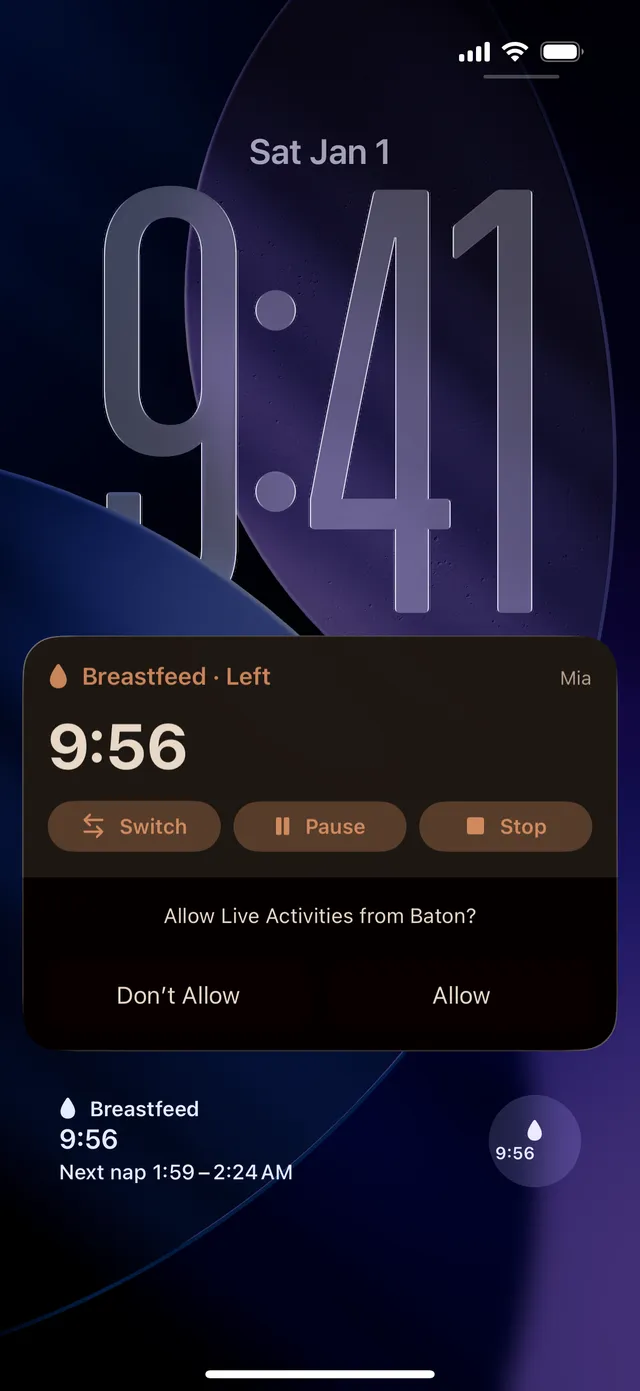
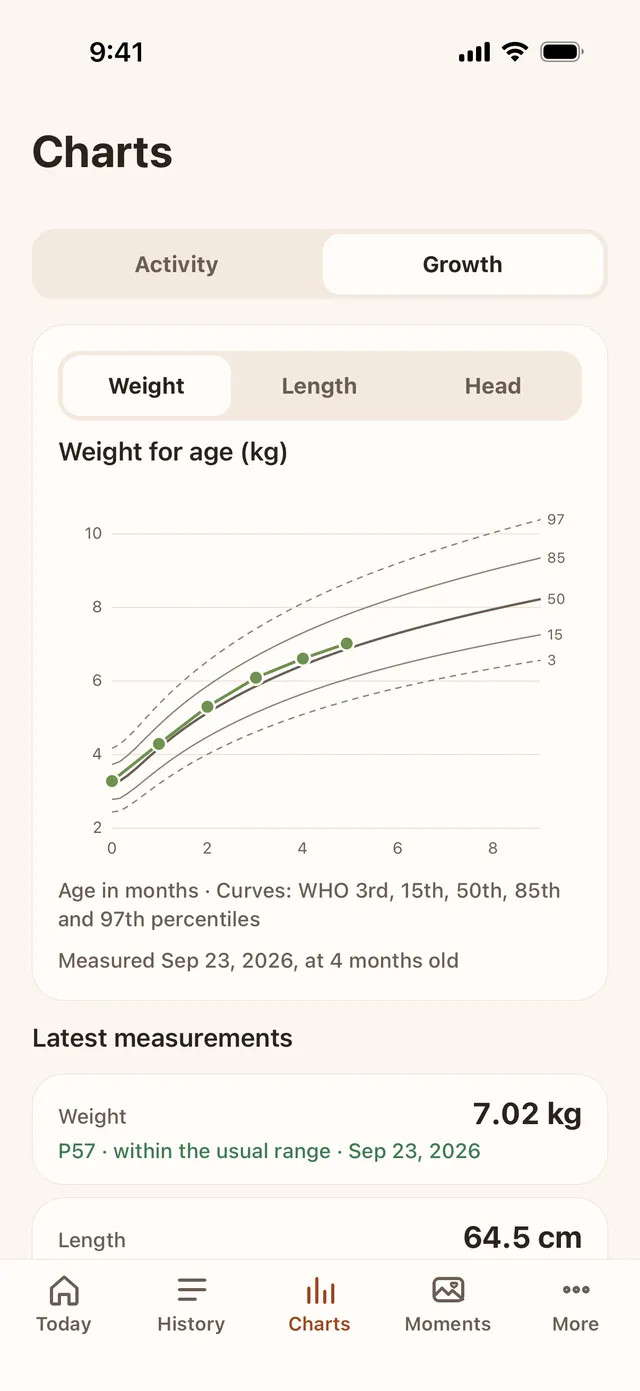
Baton is the baby's half. Breastfeed, Bottle, Pump, Solids, Sleep and Diaper are big one-handed buttons; growth entries show the WHO percentile as you type them, with the latest measurement free and the full chart history in Baton Plus; Vietnamese families get the national immunization schedule from the birth date with reminders, and anyone can add a custom vaccine with the clinic's dates. Feed and sleep timers sit on the Lock Screen and in the Dynamic Island.
Both parents log through their own iCloud, and grandparents can follow with a view-only invitation. Baton has no account, no ads and no analytics, and it never touches your Health data.