How to work out your baby's đầy tháng and thôi nôi dates on the lunar calendar
Published 1 October 2026 · Dao Van Thuong · 5 min read
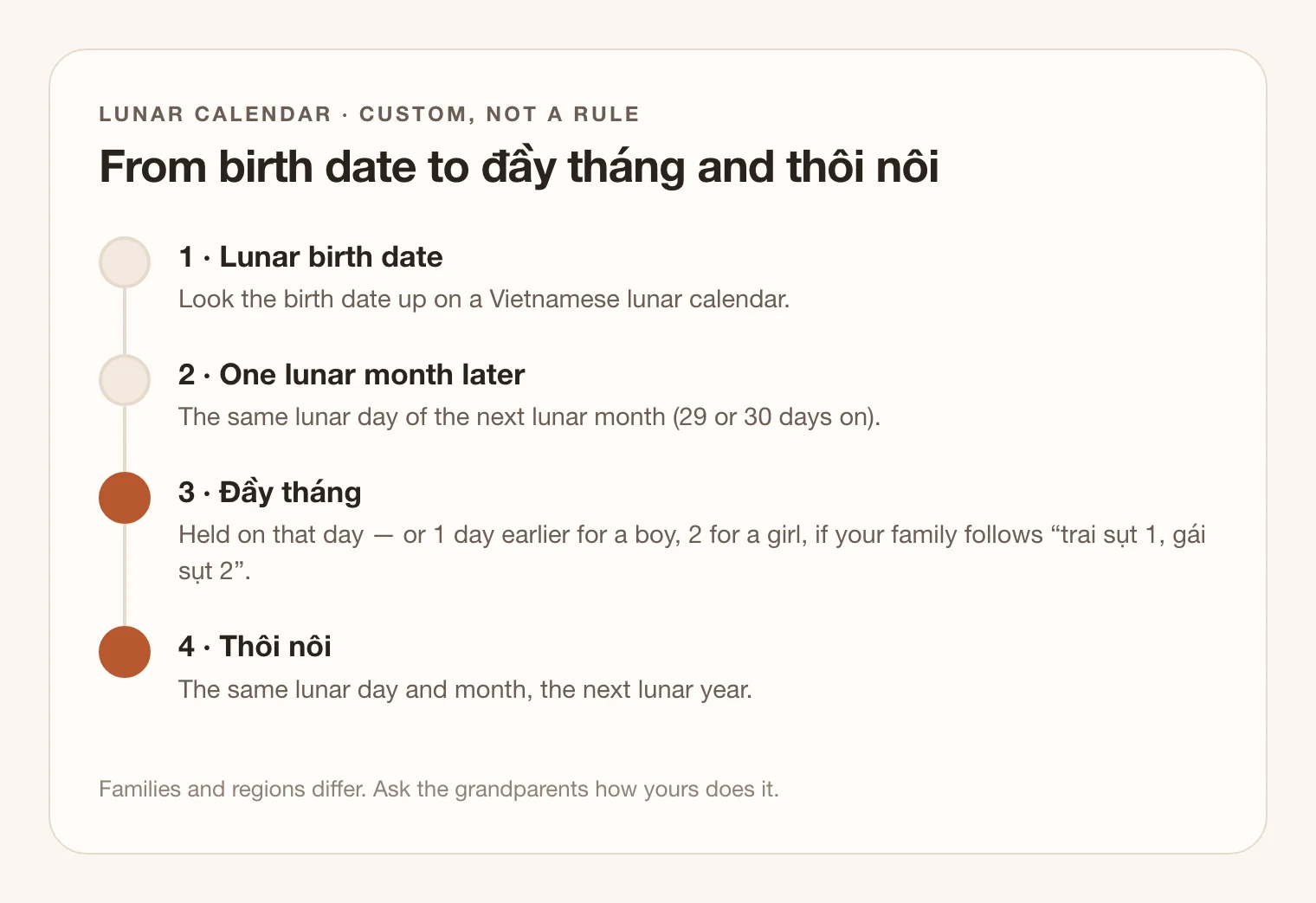
Đầy tháng, the one-month celebration, is usually counted on the lunar calendar: take the lunar date your baby was born, move to the same day of the next lunar month, and many families then hold it a little early under the saying “trai sụt 1, gái sụt 2” (a boy one day early, a girl two). Thôi nôi, the first birthday, usually falls on the same lunar date one year later.
These are customs, not rules, and families and regions do them differently. This guide shows how to work the dates out yourself with a calendar, the cases that trip people up, and when to ask the grandparents before you book anything.
Why convert to the lunar calendar first?
The birth certificate shows a solar (Gregorian) date, but the traditional ceremonies — cúng mụ, đầy tháng, thôi nôi — are counted on the lunar calendar. A lunar month is 29 or 30 days long, so “one month later” in lunar terms rarely lands on the same date of the next solar month.
So the first step is always to look up the lunar day and month your baby was born. Use a Vietnamese lunar calendar — a Vietnamese wall calendar, a tear-off calendar, or a lịch vạn niên — rather than a Chinese one. The two are calculated for different time zones (Vietnam uses UTC+7), so in the odd month they disagree by a day. If you live abroad, grandparents in Vietnam can usually read the date off the calendar on their wall in seconds.
Use the date on the birth certificate, in the time zone where the baby was born. The lunar day changes at midnight, just like the solar one.
How do you work out đầy tháng?
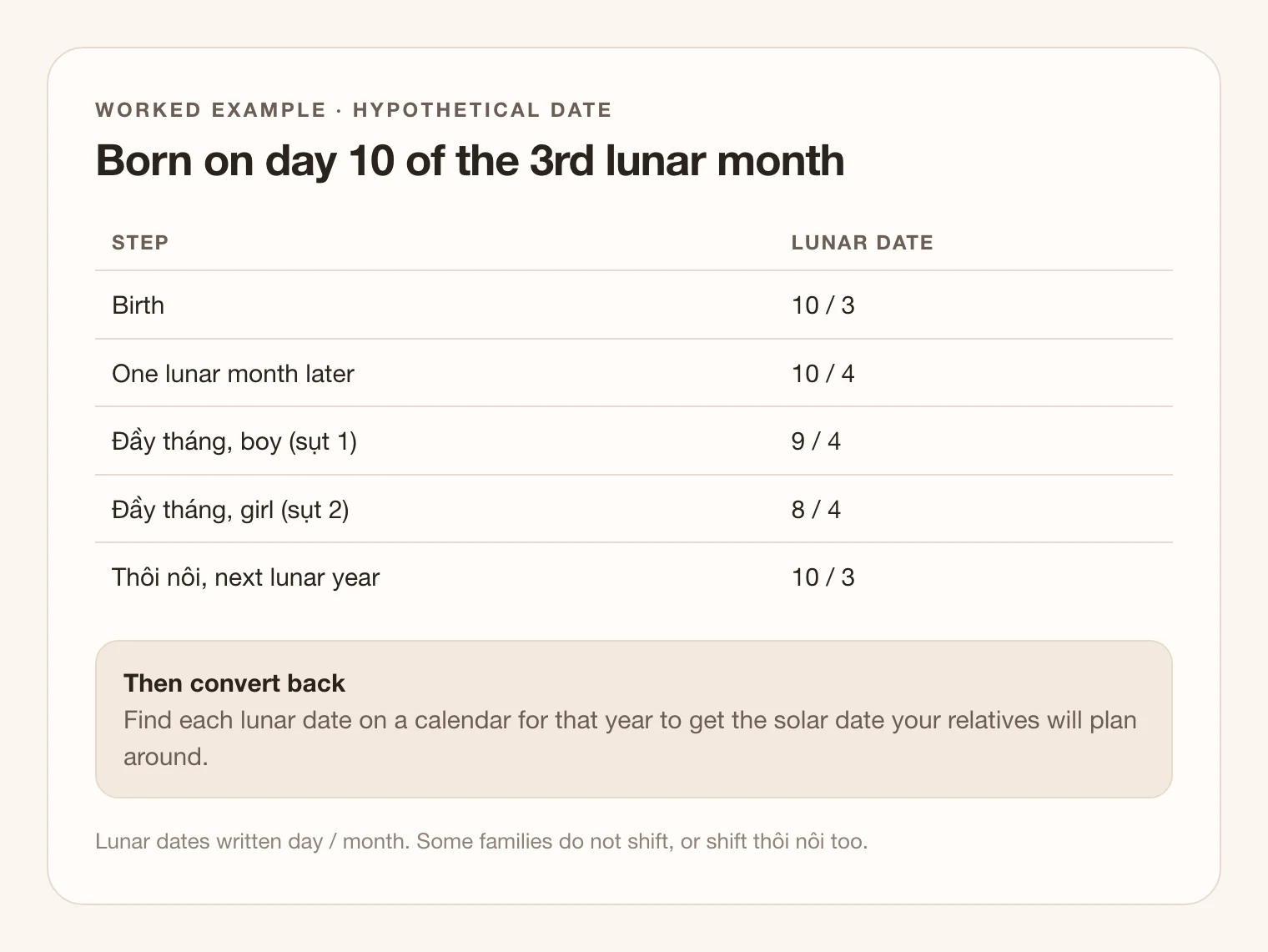
- 1Look up the lunar birth date. Example: day 10 of the 3rd lunar month.
- 2Move to the same day of the next lunar month: day 10 of the 4th lunar month. That is the baby's first lunar month-day.
- 3If your family follows “trai sụt 1, gái sụt 2”: a boy's đầy tháng is held on day 9 of the 4th month, a girl's on day 8.
- 4Look that lunar date up on the same calendar to get the solar date, because that is what relatives will plan around.
People explain the saying differently, some families flip it or use “nam trồi, nữ sụt”, some hold the ceremony on the exact day, and many simply pick the nearest weekend so guests can come. There is no single correct version — ask both sets of grandparents how your family has done it.
How do you work out thôi nôi?
Thôi nôi marks the first birthday. Most families hold it on the same lunar day and month the following lunar year: born on day 10 of the 3rd lunar month, thôi nôi falls on day 10 of the 3rd lunar month a year later.
Some families apply “trai sụt 1, gái sụt 2” to thôi nôi as well; others do not. Again, asking the older generation once saves a debate later.
Because a lunar year can contain a leap month, the lunar thôi nôi can land a few weeks away from your baby's first solar birthday. That is normal, not a mistake in your arithmetic.
What about short months and leap months?
- Born on day 30, but the next lunar month has only 29 days: many families use the last day of that month (day 29), then apply any shift.
- The next month is a leap month (tháng nhuận): đầy tháng follows the very next lunar month, leap or not. Born in the 4th month of a year with a leap 4th month, đầy tháng falls in the leap 4th month.
- A leap month falls before the first birthday: thôi nôi is still the same day and month number in the next lunar year, so it comes a little more than a solar year after the birth.
These cases are rare, but they are exactly where family discussions start. Writing the calculation down and showing it to the grandparents first is the simplest fix.
What should you plan once the date is set?
- Put both the lunar and the solar date in your phone's calendar, with a reminder a few days ahead for the offering tray, the cake or the guest list.
- Send relatives the solar date with the lunar one in brackets, so older family members can check it against their own calendar.
- If you are abroad, check the time difference for any video call with family in Vietnam — their morning ceremony may be your evening.
- If the baby or the mother still needs rest, a small ceremony at home is perfectly traditional. The custom is there to celebrate, not to wear everyone out.
- The first month also has check-ups and vaccinations. Avoid holding the ceremony on a vaccination day, since some babies are fussier afterwards.
Where Baton helps
For a Vietnamese household (Vietnam as the country, the Vietnamese vaccine schedule, or Baton in Vietnamese — and anyone can switch it on or off in Settings), Baton converts the birth date to the Vietnamese lunar calendar on the phone and shows both days: the day to hold the ceremony, the exact lunar date, and the rule it applied. For đầy tháng a boy's is one day early and a girl's two; with no sex recorded, there is no shift.
Today mentions the day from five days before, an optional reminder comes three days before and that morning, and there is a card to share with family. Baton words it as custom, not advice — if your family counts differently, follow your family. It is free, needs no account, and Baton is coming soon to the App Store.