How to track your baby's milestones with the CDC checklists
Published 1 October 2026 · Dao Van Thuong · 4 min read
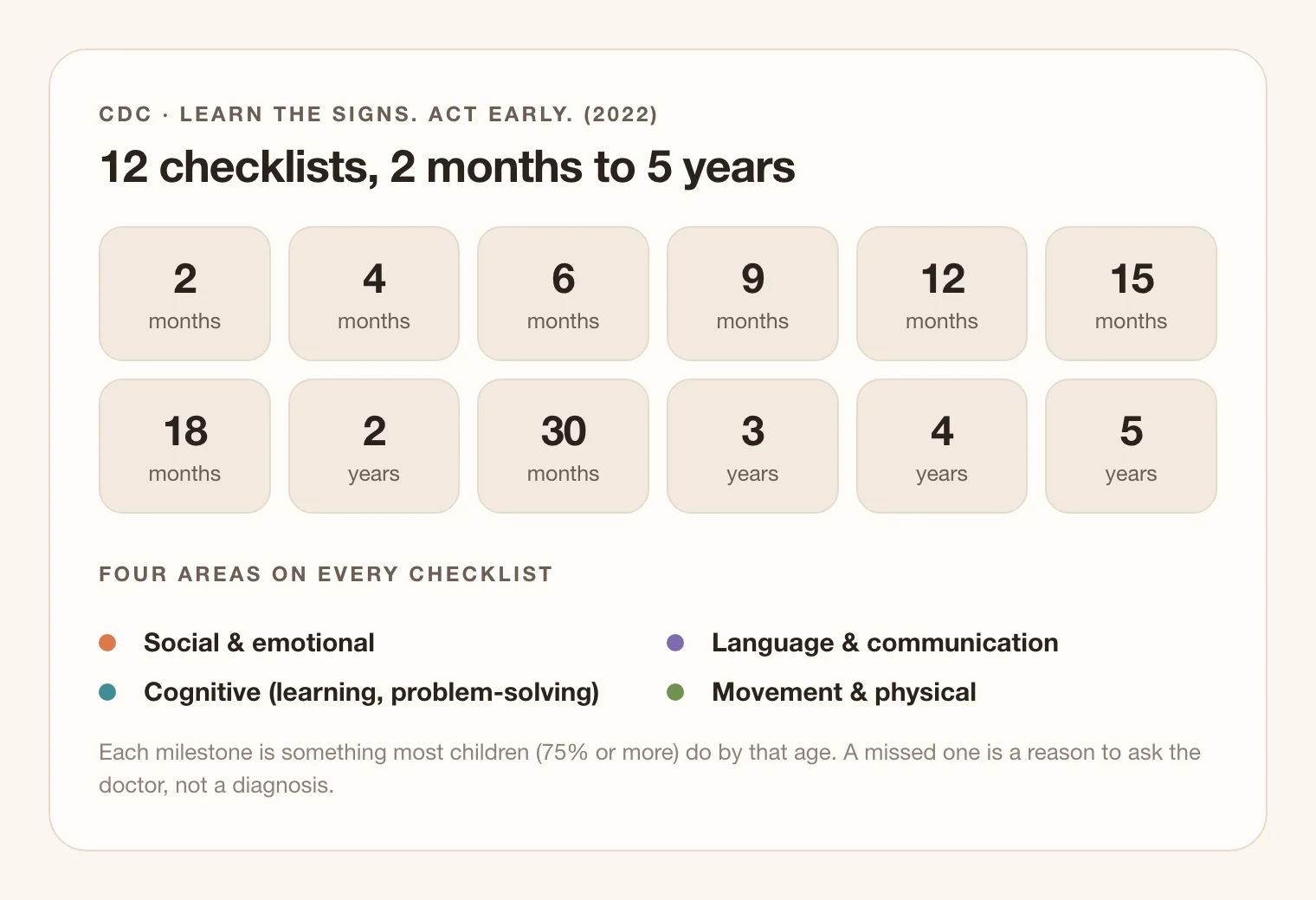
Developmental milestones are things most children can do by a certain age — smiling back, rolling over, babbling, sitting, crawling, a first word. The CDC's “Learn the Signs. Act Early.” checklists cover 12 ages from 2 months to 5 years; you tick what your child does and take the list to check-ups.
A checklist is not a test and it does not diagnose anything. It helps you watch systematically, remember when things first happened, and arrive with specific questions for the doctor.
This guide is general information, not medical advice. Follow what your doctor, midwife or health visitor told you, and call emergency services in an emergency.
What are milestones, and what is special about the CDC checklists?
Milestones fall into four areas: social and emotional, language and communication, cognitive (learning, thinking, problem-solving), and movement and physical development. A milestone listed at an age means most children can do it by then.
In 2022 the CDC and the American Academy of Pediatrics (AAP) revised the checklists so that each milestone is something most children (75% or more) do by that age, rather than an average. That way, a missed milestone is a reason to talk to the doctor early, not to wait and see.
The checklists are free on the CDC website in English, Spanish and several other languages, and the CDC also has a free Milestone Tracker app.
Which ages have a checklist?
There are 12: 2, 4, 6, 9, 12, 15 and 18 months; 2 years; 30 months; and 3, 4 and 5 years.
Those ages line up with the well-child visits the AAP recommends in the US. Where you live the schedule may differ; you can still use the checklist at whichever check-up or vaccination visit falls closest to that age.
If your baby was born early, ask the doctor whether to compare against their actual age or their corrected age (counted from the due date).
How do I record milestones on paper?
- 1Print or download the checklist for the age your baby is growing into, not the one just passed. At 3 months, look at the 4-month list.
- 2Once a week, read it through when you have a quiet moment and tick what you have seen. Only tick what you have actually watched happen, not what you think they could probably do.
- 3Write the date you first saw it next to each tick. One line is enough: “14 May — rolled from back to tummy on the play mat.”
- 4Keep a “questions for the doctor” line at the bottom of the page. Write it down when the worry comes, rather than trying to remember it in the waiting room.
- 5Photograph the page before each visit so the doctor can see it even if the notebook stays at home.
A short video often helps more than a description, especially for something your baby only does at home, like a particular sound or movement.
When should I talk to the doctor?
The CDC's advice is to act early: talk to your child's doctor if your baby is not meeting one or more milestones for their age, has lost skills they once had, or you simply feel something is not right. Ask about developmental screening.
The AAP recommends developmental screening with a standardised tool at certain check-ups in the first years, on top of ongoing monitoring. Ask your baby's doctor when that happens where you live.
Do not draw conclusions from the checklist yourself, and try not to compare with other babies. Every child has their own pace — which is exactly why the doctor does the assessing and your job is to record what you see.
How do I keep milestone tracking from becoming stressful?
- Treat the checklist as a list of ideas for play: for rolling, give your baby awake tummy time; for babbling, talk to them and pause for a “reply”.
- You do not need to check daily. Once a week is enough not to miss anything.
- Note the moments that are not on any list. The first time your baby laughs out loud at a grandparent is worth keeping too.
- If both parents are looking after the baby, record in one place, so nobody has to argue about the day of the first roll.
Where Baton helps
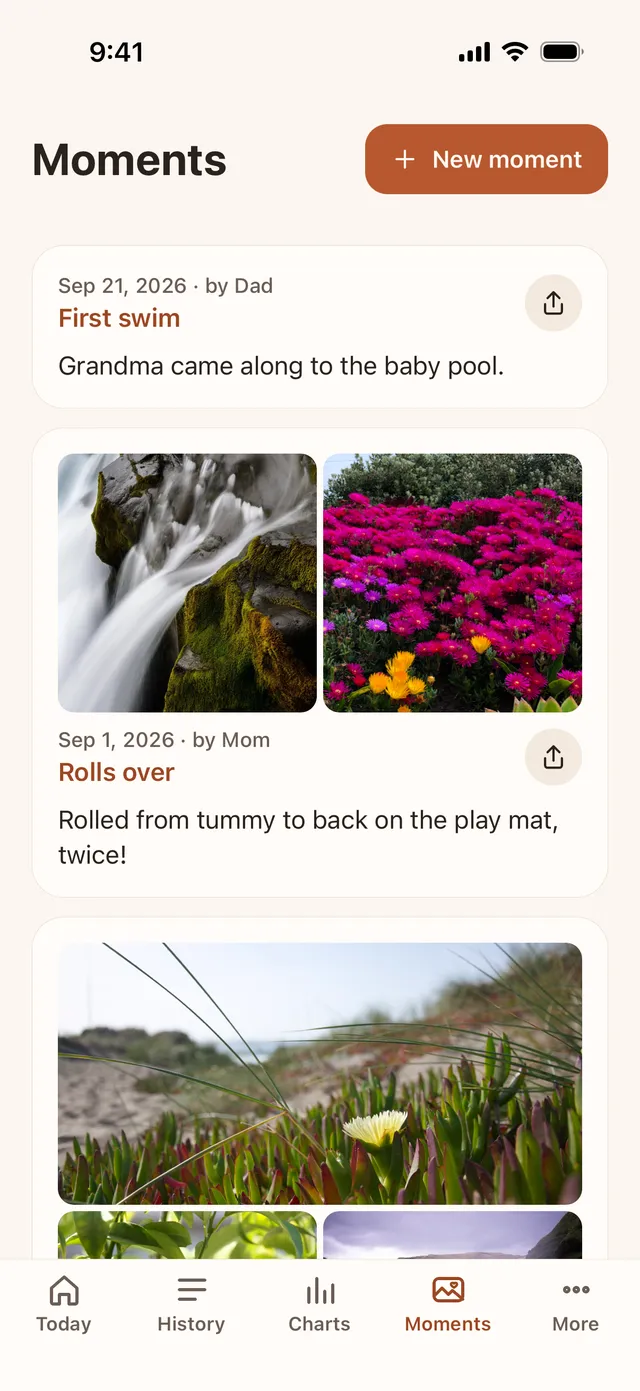
Baton includes the CDC “Learn the Signs. Act Early.” checklists from 2 months to 5 years, in four areas, opening on the age your child is growing into. Each milestone is worded as “most children do this by…”, with the source named and a gentle note to talk to your child's doctor with any question — never a score.
Ticking a milestone offers to keep it as a Moment, with a note and up to four photos. Ticks sync to your partner through iCloud, show in History and appear on that month's card. The checklists are free; the first 20 moments are free and Baton Plus makes them unlimited. No account, no ads, no analytics — and Baton is coming soon to the App Store.