Baby teething: how to log symptoms and the date of the first tooth
Published 19 October 2026 · Đào Văn Thương · 4 min read
Dribble, chewing on everything, a grumpy evening: parents often wonder whether it is teething, a cold or just a bad day. A short log will not answer that for you, but it gives you facts instead of guesses: what you noticed, on which days, and when the tooth finally showed up.
This guide covers what to write down, how to use the log when you talk to a professional, and how to do it in Baton: Baby Tracker. It is general information, not medical advice: for any symptom that worries you, call your doctor, health visitor or pharmacist.
This guide is general information, not medical advice. Follow what your doctor, midwife or health visitor told you, and call emergency services in an emergency.
When do babies start teething, and what are the usual signs?
The UK's NHS says most babies start teething at around 6 months, but some start before 4 months and some after 12 months, and a few are even born with a tooth. It also says teeth can come through with no pain at all, or with mild symptoms that last a few days.
When there are symptoms, the NHS lists sore, red gums where the tooth is coming through, a slightly raised temperature (below 38°C), one flushed cheek, a facial rash, rubbing an ear, extra dribbling, chewing a lot and being fretful or sleeping badly. It also says there is no evidence that teething causes diarrhoea. See the NHS “baby teething symptoms” page for the full, current wording.
Why keep a teething log at all?
Teething is easy to blame for everything. A log keeps you honest in two ways:
- It shows a pattern. If the dribbling and chewing started five days ago and a tooth then appears, that fits. If your baby is simply fussy every evening at the same hour, that is a different question.
- It protects you from missing something else. A cold, an ear infection or a stomach bug can look like “just teething”. Dated notes let you see that a symptom the NHS does not link to teething, such as diarrhoea, appeared, and that is worth a call.
A log is not a diagnosis. It is the notes you hand to a professional so that they do not have to rely on your memory at the end of a long week.
What should I write down?
Keep it to one line per observation, always with the day and time:
- What you see: dribbling, chewing, red gums, flushed cheek, rubbing an ear, a rash, unusual fussiness.
- Sleep and feeding changes, in a few words (“woke three times”, “took less milk at lunch”).
- Any temperature reading exactly as the thermometer shows it, and where it was taken.
- Anything you gave, with the name and dose exactly as on the label, and who gave it. Never write a dose you worked out yourself: ask your pharmacist or doctor what is suitable for your baby.
- The date you first see or feel a tooth. A first tooth is also a nice date to keep for the baby book.
When should I stop blaming teething and call someone?
The NHS advice is to get medical advice if your baby has any symptoms that worry you; you can call NHS 111 or contact a GP, and other countries have similar services. Do not wait to see what the log shows if your baby is very hot, hard to wake, refusing feeds, has fewer wet nappies, is having trouble breathing, or simply seems unwell to you. Take your log to the appointment, and read it out if the call is quick.
How do I log it in Baton?
Baton has a free Health log for exactly this. Tap Health on Today, choose Symptoms and pick the chips that apply: Teething, Fussy, Rash and others, as many as you like. Change the time if you are writing it down later, add a note in your own words, and save. The entry carries the name of the parent who logged it, so both of you see the same record. Temperatures and medicines you enter in the same Health log appear with the time, as typed.
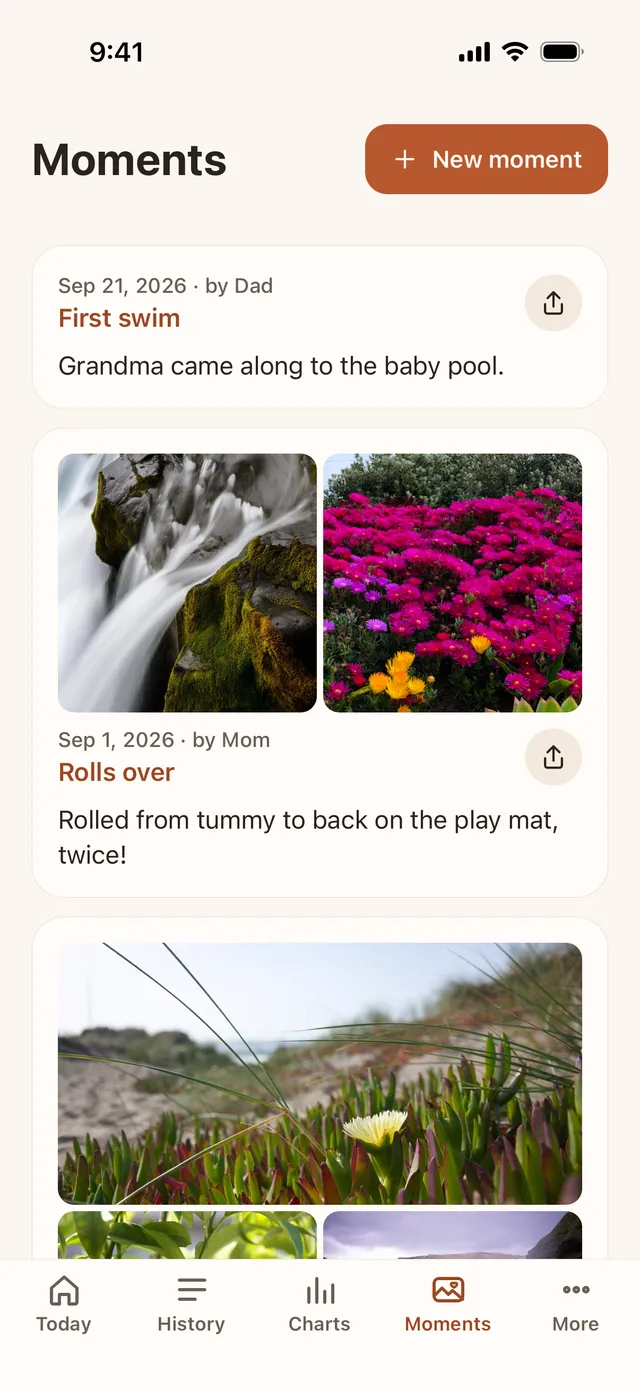
When the tooth comes through, add a moment in the Moments tab with the milestone “First tooth”, the day and, if you like, up to four photos. Moments are free up to 20 and unlimited with Baton Plus.
To see only what you logged around the tooth, use the Health filter in History. Baton Plus also adds the logged medicines, temperatures and symptoms to the PDF report you can share with your doctor, and the CSV export stays free.
Baton only records what you enter. It never decides that something is teething, never judges a temperature and never suggests a dose.
Frequently asked questions
- At what age do babies start teething?
- The NHS says most babies start at around 6 months, some before 4 months and some after 12 months, and a few are born with a tooth. Ask your health visitor or dentist if you are concerned.
- Does teething cause a fever?
- The NHS lists a slightly raised temperature, below 38°C, among possible teething symptoms. A higher temperature or a baby who is unwell needs medical advice, not a teething explanation. Write the reading and where it was taken, and call your doctor.
- Does teething cause diarrhoea?
- The NHS says there is no evidence that it does. If your baby has diarrhoea, write down when it started and ask a doctor or pharmacist rather than assuming it is teething.
- Can I log teething in a baby tracker app?
- Yes. In Baton, Health → Symptoms has a Teething chip, and the Moments tab has a “First tooth” milestone with a date and photos. Both are free apart from Moments past 20 entries.
- Does Baton tell me if my baby is teething?
- No. Baton records what you enter and shows it back. It does not diagnose or judge symptoms.