How much tummy time does a baby need? How to keep a simple tummy-time log
Published 8 November 2026 · Đào Văn Thương · 4 min read
“How much tummy time does my baby need, and am I doing enough?” is a question parents type in after a baby who cries the moment they are put down on their front. Public health sources agree on the general shape: start early, keep sessions short, only when your baby is awake and someone is watching, and build up as your baby gets stronger. Exact minutes differ between sources, so this guide does not promise a number.
What it does cover is what is worth writing down so that you and your partner can see how it is going, and how to keep that record on paper or in Baton: Baby Tracker. It is general information, not medical advice. Whether your baby's development is on track is a question for your pediatrician, midwife or health visitor.
This guide is general information, not medical advice. Follow what your doctor, midwife or health visitor told you, and call emergency services in an emergency.
What do public health sources say about tummy time?
The US NICHD Safe to Sleep campaign describes tummy time as time on the tummy while your baby is awake and someone is watching, and says most babies can start within a day or two of birth. The same campaign is clear that babies sleep on their backs, on a firm flat surface: tummy time is play, never sleep.
Sources such as the NICHD, the American Academy of Pediatrics and the NHS describe the same idea: begin with a few short sessions a day, then lengthen them as your baby gets stronger and enjoys it more. The exact minutes and the target for each month vary from page to page, so read the current page itself, and ask your pediatrician what suits your baby. Premature babies or babies with a health condition may need different advice.
Why would you write it down at all?
Most families do not need to count minutes. A log is useful for the parents who find themselves asking “did we do any today?” at 9 PM, or who share the day between two people and a grandparent, and for the appointment where someone asks how tummy time is going.
It also helps you notice what works. If your baby tolerates it better after a nap than just after a feed, or on a play mat rather than on your chest, a few lines will show it faster than memory.
What is worth writing down?
Keep it to one line per session:
- The time and roughly how long, a rough figure is fine.
- How it went: happy, fussy, cried after a minute.
- What you tried: on a play mat, on your chest, across your lap.
- Anything new you saw: lifting the head, pushing up on the arms, rolling. Write the date, because these are the things the milestone checklists ask about.
- Anything that worries you, in plain words: baby seems to dislike it every time, always turns the head to one side, or the head looks flat in one spot. Take that note to your pediatrician.
Our guide to the CDC milestone checklists explains the milestones that tummy time builds towards.
How do I keep a tummy-time log in Baton?
Baton has no tummy-time button or timer, and it does not count or judge tummy time. It does have a Note: tap Note on the Today screen, write one line such as “tummy time on the play mat, about 3 minutes, cried at the end”, and save. Every entry has an editable time and shows who logged it, so a note you add after the fact can carry the right time, and your partner's notes join yours.
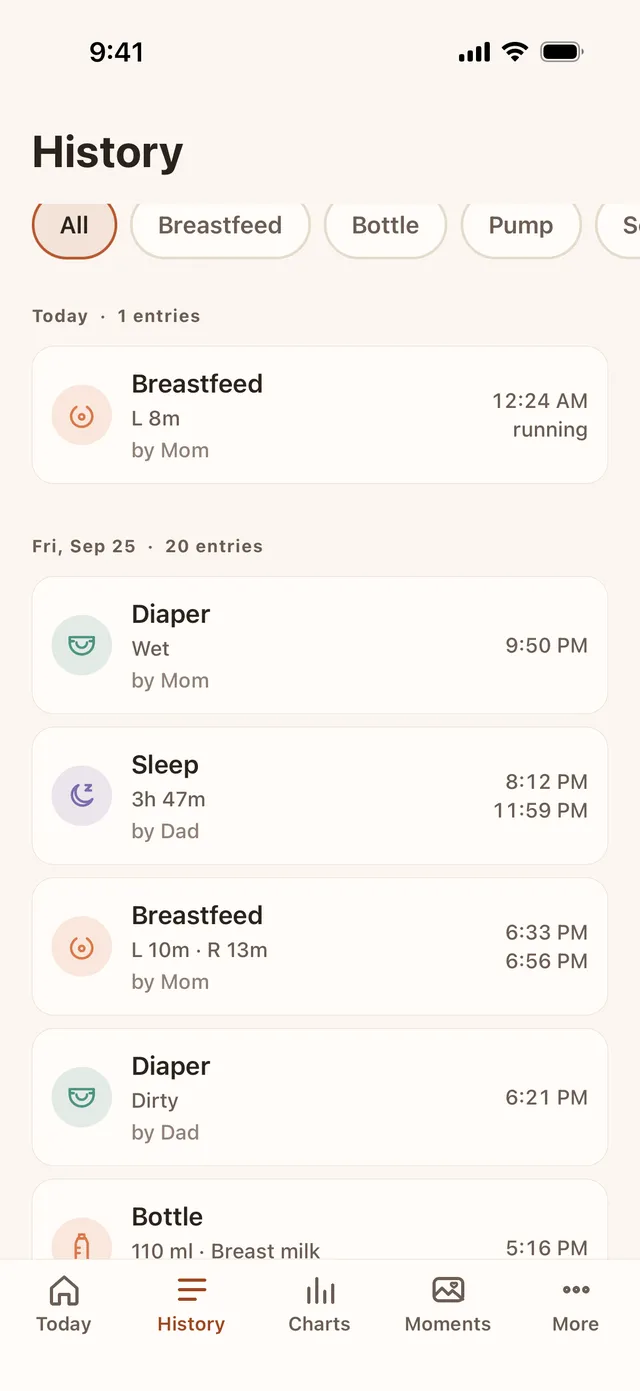
In History, notes sit in time order among your feeds, sleeps and diapers, so you can scroll back over a few days and see when tummy time happened. CSV export is free and has a note column, so you can search your notes in a spreadsheet. For an appointment, show the History screen or send the CSV.
When should I ask someone?
Ask your pediatrician, midwife or health visitor if your baby seems very unhappy on the tummy every time, if you are worried about head control, a flat spot on the head, or a head that always turns to one side, or if you simply want to know whether what you are doing is enough. Bring your notes.
Stop tummy time and pick your baby up if they fall asleep, and put them to sleep on their back. If your baby ever struggles to breathe or is hard to wake, call your emergency number.
Frequently asked questions
- When can I start tummy time?
- The NICHD Safe to Sleep campaign says most babies can start within a day or two of birth. Ask your pediatrician first if your baby was premature or has a health condition.
- Can my baby sleep on their tummy during tummy time?
- No. Tummy time is only for when your baby is awake and someone is watching. If your baby falls asleep, turn them onto their back on a firm flat sleep surface.
- How many minutes of tummy time is enough?
- Sources differ, so check the current NICHD, AAP or NHS page and ask your pediatrician. They agree on starting with short sessions and building up as your baby gets stronger.
- Does Baton have a tummy-time timer?
- No. Baton has no tummy-time button or timer and gives no assessment. You can add a Note, read it in History next to your feeds, sleeps and diapers, and export it in the free CSV.